Yes, data annotation is legit: it is real, paid work, and so are the scams that copy it. AI companies pay people to label data, rate chatbot answers and check facts. DataAnnotation Tech itself is a real company, not a fake: its terms of use are a contract with Surge Labs, Inc., and Forbes reported in 2025 that it is a wholly owned affiliate of Surge AI. DataAnnotation (dataannotation.tech), the platform most people mean, advertises up to $40 to $50 an hour for language and generalist work after a qualification step, and its website mentions no fee to join.
The quick test: walk away if an offer asks you to pay for training or a "starter kit", sends you a check to deposit, or moves you to WhatsApp or Telegram before any test or contract. The U.S. Federal Trade Commission puts it in one line: if you have to pay to get a job, it is a scam.
The question is searched about 12,100 times a month in the US (DataForSEO, October 2026). Below: what the work involves, what DataAnnotation states on its own site, all six red flags, a five-minute check and where to find legitimate roles.
What data annotation work really is
Data annotation work means making or checking the examples that AI models learn from. The work comes in a few forms:
- Labeling data: tagging images, drawing boxes around objects, transcribing audio, classifying text.
- Rating model answers: comparing two answers from an AI and choosing the better one, following written guidelines. This is the human feedback behind techniques such as RLHF.
- Writing and correcting: writing ideal answers, fixing wrong ones, checking facts and sources.
- Expert evaluation: reviewing answers in a field you know: medicine, law, finance, coding, mathematics, a language.
The more expertise a task needs, the better it pays. Simple labeling is the entry level; coding, maths and specialist domains are at the top.
Is DataAnnotation Tech legit or fake?
Most people searching this question mean DataAnnotation (dataannotation.tech), one of the best-known platforms. Yes, DataAnnotation Tech is real: it pays people to train AI models, and the company behind it is a known AI data business. Here is what its own pages and the press say, read on October 31, 2026.
Who runs it. Its terms of use are a contract with "Surge Labs, Inc., a Delaware corporation," governed by California law. According to Forbes in September 2025, Surge AI "hires annotators through a wholly owned affiliate called DataAnnotation Tech."
Forbes also noted that "neither its job listings nor the website used by annotators mentions Surge by name" in its report. So you will not see the parent company on the site, and that is not a sign of a scam.
What the work is. The site describes "reviewing responses, checking accuracy, refining prompts, and rating outputs," plus "ranking responses, checking facts, labeling data." Its FAQ says there are "no minimum hours or daily login requirements."
How you join. There is no interview. The FAQ says "No recruiters. No interviews."
Instead, you take a Starter Assessment of about an hour. Take it when you have time to do it well, because "you can only take the Starter Assessment once" according to the FAQ. Results come by email within a few days. You must be at least 18 and fluent in English.
How you are paid. "We send payments via PayPal," says the FAQ, and "deposits will be delivered within a few days after you request them." The terms say all payments are in U.S. dollars.
What it advertises. The home page lists up to $40 an hour for language roles, up to $50 for generalist work, up to $125+ for professional and STEM roles and up to $150+ for coding and data roles. For general projects, the FAQ gives "starting at $25-$50 per hour."
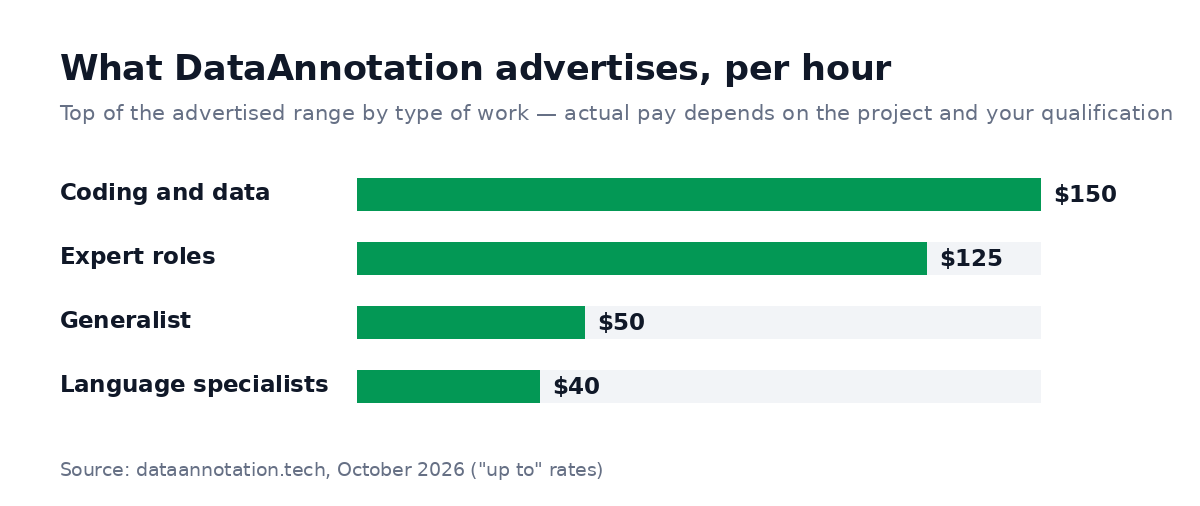
"Up to" rates from dataannotation.tech, October 2026. Actual pay depends on the project and your qualification.
What workers report. On Trustpilot, DataAnnotation has a TrustScore of 3.9 ("Great") from 1,978 reviews, with 21% one-star reviews (read October 31, 2026). In the one-star reviews we read on October 31, the common complaints were an empty project board after the assessment, no answer after applying, and accounts closed.
The FAQ explains why the board can stay empty. "Workers are added to projects based on expertise and performance," so work depends on demand for your skills and on your past results.
In May 2025, Bloomberg Law reported that a proposed class action filed in California state court accuses Surge Labs of misclassifying annotators as contractors. These are allegations, not findings, and we could not confirm the case's current status.
So it is a real platform that pays for real work, with two things to keep in mind:
- Work is not guaranteed. Projects come and go, and the hours available to you can change from one week to the next. Treat it as flexible income, not a salary.
- The impersonators are the problem. DataAnnotation's trust page warns that people have used its name "to commit fraud." The same page promises it will never ask you for money. So apply only through its official sign-up flow, and ignore anyone who contacts you outside its official channels.
The red flags of a data annotation scam
The clearest red flag is a request for money. The U.S. Federal Trade Commission's guidance on job scams is blunt: "If someone asks you to pay to get a job, that's a scam." In AI training work, scams usually show one or more of these signs:
- You must pay first: for training, software, a certification, a "starter kit" or equipment.
- A check you must deposit and partly send back, or use to buy equipment. The check bounces days later; the money you sent is gone.
- Pay that is too good for the work. "$80–160 an hour, no experience needed" for vague tasks is a lure, not an offer.
- A recruiter with a personal or throwaway email, or a company whose website does not match its name.
- The conversation moves to WhatsApp or Telegram quickly, with pressure to decide today.
- They ask for bank details or ID documents before any contract or interview.
We see these patterns on RemoteAI too. In October 2026 we turned away job posts sent from throwaway email addresses that offered high hourly pay for vague "generalist" AI work, under company names that matched no real website. Since then, the free job post (one a month) of a company without a verified website waits for a manual review before it goes live.
How to check an offer in five minutes
- Search the company name plus "scam" or "review", and check that the website and the email domain match.
- Never pay anything to get or start the job.
- Look for a real application process: a qualification test, guidelines, a contract or terms of work.
- Check how you will be paid (the platform, the schedule, the minimum payout) before you work.
- Keep everything on the platform until you have a signed agreement.
Where to find legitimate AI training work
- Established platforms that run AI training projects for model makers, with a public application process.
- Direct roles at AI companies and their data partners: AI trainer, data annotator, model evaluator, AI tutor, posted on their own career pages.
- Specialist job boards that check who posts. On RemoteAI, imported jobs come from employers' own career pages, and you can browse AI training jobs and data annotation jobs, or all remote AI jobs.
How to get the better-paid projects
The best-paid annotation and evaluation work goes to people with a clear specialty. To move up:
- Lead with your domain. A nurse, an accountant, a lawyer, a developer or a native speaker of an in-demand language is worth more than a generalist. Say it first.
- Show you follow guidelines. Accuracy and consistency matter more than speed; mention quality scores or reviews if you have them.
- Learn the vocabulary: RLHF, preference ranking, rubric-based evaluation, red teaming. Companies search for these terms.
- Add one adjacent skill: basic Python, prompt writing or spreadsheet analysis opens evaluation and data quality roles. Our study of the AI skills in demand shows which ones companies ask for most.
Where annotation work can lead
Annotation is often seen as a side job, but it is also one of the few open doors into AI work without a computer science degree. People who do it well tend to move along one of these paths:
- Senior evaluator or reviewer: checking other annotators' work, writing and improving the guidelines, handling the hardest cases.
- Domain expert for AI: medical, legal, financial or language specialists who evaluate model answers in their field, usually the best-paid track.
- Red teaming and AI safety: trying to make models fail or say harmful things, then documenting how. It needs creativity and careful writing more than code.
- Data quality and operations: organizing annotation projects, measuring agreement between annotators, spotting bad data before it reaches a model.
- Prompt writing and AI product testing: many teams hire people who understand how models fail to test new AI features before launch.
Each step builds on the same habits: precise writing, consistent judgement and the ability to explain why an answer is good or bad. Keep a short record of the projects you worked on, the guidelines you followed and any quality scores. It becomes your portfolio when you apply for the next role.
The bottom line
Data annotation and AI training work is legitimate, growing work, and a good way to start in AI if you have a field you know well. Stay clear of anything that asks you to pay, to deposit a check or to move to a messaging app, and check every company before you share personal details.
Ready to find real AI work? Create your free profile. RemoteAI matches you with AI training and evaluation roles from real employers, and companies can invite you directly.
Sources: DataAnnotation, FAQ, trust and safety and terms of use, read October 31, 2026; Forbes, via Forbes Australia, September 17, 2025; Bloomberg Law, Surge AI hit with worker misclassification suit, May 20, 2025; Trustpilot, dataannotation.tech, read October 31, 2026; U.S. Federal Trade Commission, Job scams.