An AI automation agency takes a process that eats hours every week, such as copying leads into a CRM, sorting support emails or chasing invoices, and turns it into workflows that run on their own. The AI part reads messy input and decides what to do with it. The automation part moves the data between your tools.
Before you sign with one, it helps to know what the work includes, how it is priced at each size, and when a single specialist can do the same job. This guide covers all three, with a 12-month budget you can adapt.
What an AI automation agency does
Most agency projects follow the same five steps, whatever the tools:
- Map the process. Who does what today, how often, with which tools, and where mistakes happen.
- Connect the tools. Workflows on platforms such as n8n, Zapier or Make link your CRM, inbox, forms, spreadsheets and help desk.
- Add AI steps. A model classifies an email, extracts fields from an invoice or drafts a reply. For example: "Read the inquiry, tag it as sales, support or billing, and draft a first answer for a person to approve."
- Test and document. The workflows run on real examples, each one is written up, and errors send an alert to a person.
- Maintain. Tools change their APIs, your prices and rules change, and someone has to keep the workflows working.
The difference with plain automation is step 3. If every input arrives in a fixed format, you may not need AI at all, and a simpler workflow is cheaper and more predictable. Our comparison of n8n vs Zapier helps you pick the platform.
What AI automation projects cost
Prices depend first on the size of the project, then on who delivers it. Custom automation has no standard price, so the table shows how each size is usually priced rather than a number.
| Project size | What it includes | How it is usually priced |
|---|---|---|
| Single workflow | One process automated, a few steps and tools connected, error alerts | Often a fixed package (see below) |
| AI automation package | Several connected workflows, AI steps (classify, extract, draft), self-hosted n8n setup if needed, documentation and monitoring | Fixed quote per milestone |
| Automation system | Company-wide automation map, custom nodes and APIs, migration from Zapier or Make to n8n, ongoing maintenance plan | Custom quote, usually in phases |
Small jobs are sold as packages with a set price. In its service templates, RemoteAI suggests specialists start at $150 for one workflow of up to 5 steps with 2 tool connections and an error alert, $400 for one workflow of up to 15 steps with an AI step that classifies, summarizes or writes, plus documentation and a video, and $900 for up to 3 connected workflows with AI steps, data checks and 2 weeks of support (October 2026). Anything bigger, such as a company-wide system, is quoted separately.
For a wider view, Clutch's pricing page reports that AI development projects reviewed on its site typically cost $10,000 to $49,999, with an average of about $120,600 (updated September 21, 2026). That figure covers all AI development, including custom models and apps, so it sits well above a typical automation project.
A 12-month budget example
Here is an AI automation package for a sales team: inbound inquiries are read, tagged, enriched and logged in the CRM, with a drafted reply for approval. It handles about 3,000 runs a month. Every line is an assumption you can replace with your own numbers. All amounts are in US dollars, before tax. The build assumes your CRM and inbox already exist; new software licenses and paid data enrichment are not included.
| Cost item | Assumption | 12 months |
|---|---|---|
| Build: mapping, workflows, AI steps | Assumed fixed quote of $5,000; replace it with the quotes you receive | $5,000 |
| Data work | You supply 50 past inquiries with the right tag and answer; the specialist tests on them (part of the build) | included |
| Platform | Self-hosted n8n on a small server, assumed $10 a month | $120 |
| Model usage | Claude Sonnet 5.5, 3,000 runs a month, about 1,500 tokens in and 200 out per run | about $180 |
| Maintenance | Assumed 2 hours a month at an assumed $60 an hour; use the rate in your quote | $1,440 |
| Your team's time | About 6 hours to explain the process and check examples, then 1 hour a month reviewing samples | about 18 hours |
| Total | about $6,740 plus about 18 hours of your time |
Model usage comes from October 2026 prices on claude.com/pricing: about $15 a month with Sonnet 5.5, or about $0.75 with Haiku 5.5 for simple tagging. If your company already pays for Claude Max ($100 a month of API credits), Ultra ($200 a month of API credits) or Team (up to $500 a month pooled), those credits can cover usage of this size.
Maintenance is about a fifth of the total. A quote can stop at the build, so ask for the maintenance line in writing before you compare offers. If you use n8n's hosted plan or Zapier instead of a self-hosted server, replace the platform line with that plan's yearly price.
Agency or freelance specialist?
Both deliver the same workflows. The choice depends on how many people and departments the project needs:
| Independent specialist | Agency | |
|---|---|---|
| Best for | One process or one package of workflows | Several departments, several builders at once |
| Who you talk to | The person who builds it | An account or project manager, then the team |
| Price | Builder's rate only | Builder's rate plus project management and margin |
| Continuity | Ask for documentation and a recorded hand-over | A team can cover if one person leaves |
For a first project, one experienced specialist is often enough. If the first package works, you can add workflows one at a time, or bring in an agency once the scope spans the whole company. Our guide on implementation of AI explains how to choose that first process.
What RemoteAI data shows
Automation work is a specialty, and few profiles list it by name. On RemoteAI, 92 public profiles list automation skills, and 62 live job posts ask for n8n, Zapier, Make or AI automation work:
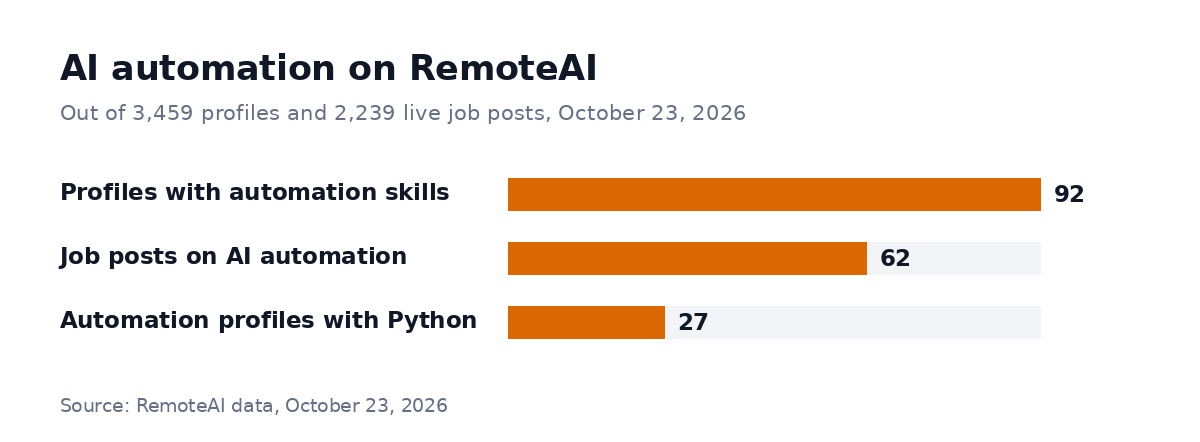
Method: counted on October 23, 2026. Profiles: the 3,459 public talent profiles on RemoteAI; a profile counts when one of its self-declared skills names automation, n8n, Zapier or Make (test automation excluded). Job posts: the 2,239 live job posts, whose title or description mentions n8n, Zapier, Make, workflow automation or AI automation. Python: the automation profiles whose skills also include Python. Profiles and job posts are counted separately.
Python matters when a workflow needs a custom step that no ready-made node covers. Ask whether the specialist can write one, or whether every step must fit the platform's built-in blocks.
Questions to ask before you sign
Whichever you hire, these five questions help separate builders who have shipped from those who have only built demos:
- "Show me a workflow running in production." Ask what happens when an input is messy or an app is down.
- "Whose accounts will it run in?" The n8n, Zapier or Make workspace, the API keys and the CRM connections should belong to your company.
- "How will we know it works?" Ask for a test on your own examples before launch and an alert to a named person when a run fails.
- "What is not in the quote?" Platform plan, model usage, connector fees and maintenance are the usual gaps.
- "What do we get at the end?" Documentation of each workflow, a recorded hand-over and a list of what to check each month.
How to start
To start, take one process through these four steps:
- Pick a process that someone does many times a week, with clear rules.
- Write down the steps and collect 50 real examples, including the awkward ones.
- Choose the smallest project size in the table that covers it.
- Post the project with the process, your tools, your examples and your budget range.
You can browse n8n, Zapier and Make experts or AI automation specialists on RemoteAI. You can also post your automation project: the free plan covers one job a month, open for 14 days, with an account (our team reviews jobs first when your company website is not verified yet), or it is $99 with no account. Ask each applicant to show a workflow they have shipped. For the agent side of automation, see our guide to the AI agent for business.
Sources: Clutch AI development pricing, updated September 21, 2026. Claude API pricing, checked October 23, 2026 (Sonnet 5.5 $2/$10, Haiku 5.5 $0.10/$0.50 per million input/output tokens). RemoteAI service templates (suggested starting prices), October 2026. RemoteAI counts: method under the chart.