Many companies do not need a new AI product. They need AI integration services: someone to connect a model like GPT or Claude to the tools the team already uses, so it reads the ticket, the contract or the lead where the work already happens.
The phrase covers very different jobs, from one automated workflow to a company-wide project. This guide explains what the work includes, five common scopes and how they are priced, a 12-month budget, the questions to ask a provider, and how to choose between a freelancer and an agency.
What AI integration actually means
An integration has four parts, and if a quote you receive skips one, you should ask why:
- Connect the data. The model gets access to what it needs: emails, tickets, documents, CRM records, a database. This is usually done through APIs, and it is where most of the build time goes.
- Write the rules. Prompts, examples and limits tell the model what to do and what never to do. For example: "If the refund is above $200, draft the reply but send it to a manager."
- Test on real cases. The provider runs the integration on 50 to 200 of your own examples, including the awkward ones, and measures how often it is right.
- Monitor once live. Logs, error alerts and a monthly review, because your products, prices and policies change.
The difference with plain automation (n8n, Zapier, Make) is the reading step. Automation moves data in a fixed format. An AI integration reads messy input, a free-text email or a scanned invoice, and decides what to do with it. Many good systems use both. Our guide to n8n vs Zapier covers the automation side.
Five common scopes and how they are priced
The table runs from the smallest scope to the largest. Custom integrations have no standard price, so the column below says what drives the quote rather than giving a number.
| Scope | Typical content | What drives the quote | Hiring page |
|---|---|---|---|
| Single workflow | One trigger, one AI step, one tool, for example sorting inbound emails into a CRM | Number of steps and tools connected | n8n, Zapier and Make experts |
| Website FAQ chatbot | A chatbot trained on your help pages, with hand-off to a person | How many pages it learns from, and whether it connects to your help desk | chatbot developers |
| OpenAI API integration | A model API inside your own app or back office: chat completion, prompts, streaming and simple function calling | How many screens or processes call the model, and how much testing they need | OpenAI API developers |
| Basic RAG prototype | The model answers from your own documents and cites them | How many documents, in which formats, and how answers are checked | RAG engineers |
| End-to-end AI integration project | Several systems connected, team training and an ROI measure | Number of systems and teams involved | AI implementation consultants |
Start at the top of the table and move down only when the simpler scope cannot do the job you need. A first project often fits in the first three rows: one task, one or two tools.
The first two rows are also sold as fixed packages. In its service templates, RemoteAI suggests specialists start at $150, $400 or $900 for an automation package: the basic one covers one workflow of up to 5 steps with 2 tool connections and an error alert, the premium one up to 3 connected workflows with AI steps and data checks. For a chatbot package the suggested starting prices are $250, $600 or $1,200, from a website widget trained on up to 50 pages to a bot on your website and WhatsApp connected to your help desk (October 2026). Bigger or custom scopes are quoted separately. For anything larger, ask for a fixed quote per milestone, with the deliverables written down.
What it costs to run
You also pay the AI provider for every call, measured in tokens (pieces of text read and written). For most integrations this is the smallest line.
An illustration: a help desk sends each new ticket to a model that summarizes it, tags it and drafts a first reply. That is 2,000 tickets a month, each one call of about 2,000 tokens in and 300 out. At October 2026 prices on claude.com/pricing, that costs about $14 a month with Claude Sonnet 5.5 and about $0.70 with Claude Haiku 5.5.
If your company already pays for Claude Max or Team, those plans include monthly API credits that can cover a first integration (claude.com/pricing, checked October 23, 2026).
A 12-month budget example
Here is the OpenAI API integration scope from the table, applied to the help desk example. We price usage on Claude Sonnet 5.5; the same scope and hourly rates apply if you use OpenAI's API, with its own per-token prices. Every line is an assumption you can replace with your own numbers.
| Cost item | Assumption | 12 months |
|---|---|---|
| Build: setup and connections | Assumed fixed quote of $4,000; replace it with the quotes you receive | $4,000 |
| Data work | You export 200 past tickets with their correct answers; the developer tests on them (part of the build) | included |
| Model usage | Claude Sonnet 5.5, 2,000 tickets a month, as above | about $170 |
| Fixed fees | Runs on your existing help desk plan and an existing server | $0 |
| Maintenance | Assumed 3 hours a month at an assumed $100 an hour; use the rate in your quote | $3,600 |
| Your team's time | About 8 hours to prepare examples and rules, then 2 hours a month checking samples | about 32 hours |
| Total | about $7,770 plus about 32 hours of your time |
All amounts in US dollars, before tax. The build excludes new features after launch; maintenance covers monitoring, fixes and updating the rules and test examples when your policies change.
Notice where your money goes: maintenance costs almost as much as the build. A quote that covers only the build is missing half the bill. If the integration needs a paid connector or a hosted automation plan, add its yearly price.
To judge whether it pays off, compare the total with the time the task takes today. If an agent spends 4 minutes per ticket on the work the integration now does, 2,000 tickets a month is about 133 hours. If the drafts are good enough to send after a quick check, a large part of those hours comes back; measure it on your first month of samples.
What the market looks like on RemoteAI
About 1 in 5 job posts on RemoteAI mentions AI integration. Of the 2,239 live job posts on RemoteAI, 490 (22%) mention integration together with LLMs, OpenAI, GPT or generative AI. On the talent side, the skills behind integration projects are common among public profiles:
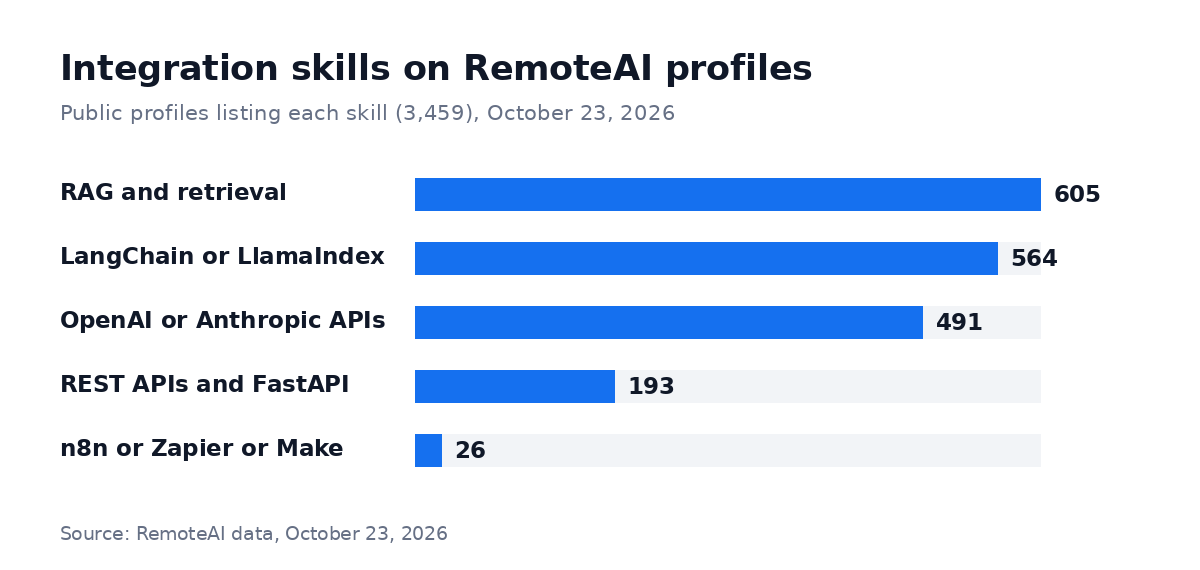
Method: counted on October 23, 2026. Profiles: the 3,459 public talent profiles on RemoteAI; a profile counts in a bar when one of its self-declared skills names that technology. Job posts: the 2,239 live job posts, whose title or description mentions integration and also LLMs, OpenAI, GPT, large language models or generative AI.
The no-code bar counts only profiles that list n8n, Zapier or Make by name; many automation builders describe the work instead of listing each tool. For a workflow project, search the n8n, Zapier and Make experts page directly.
Questions to ask before you sign
Five questions separate providers who have shipped integrations from those who have only built demos:
- "Show me one running on real data." A screen share of a live integration beats any portfolio. Ask what it does when the input is messy or a field is missing.
- "What happens when the model or a tool is down?" You want retries, a fallback such as routing the item to a person, and an alert. An integration that fails quietly is worse than none.
- "How will we know it is right?" Ask for an accuracy test on your own examples before launch and a sample review each month after.
- "Who owns the accounts and the code?" API keys, automation workspaces and repositories should be in your company's name, so you can change providers.
- "What is not in the quote?" Look for model usage, connector fees, hosting and maintenance. These are the lines that surprise people later.
Freelancer or agency?
Both can do the work. Your choice depends on the size of the project and how much coordination you need:
| Independent specialist | Agency | |
|---|---|---|
| Best for | One or two integrations with clear scope | Several systems at once, many people, formal procurement |
| Speed | You talk to the person who builds it | Account manager and project manager in between |
| Cost | No agency margin | Higher day rates, broader team |
| Risk | Depends on one person; ask about hand-over documents | Staff changes during the project |
For a first integration, an independent specialist is usually enough. Ask for documentation and a recorded hand-over, so someone else can maintain it later. Our guide on implementation of AI explains how to pick that first project.
How to start
To start, take your first project through these four steps:
- Pick one task that someone does many times a week, with a clear right answer, such as tagging tickets or extracting invoice fields.
- Collect 50 to 200 real examples with the correct result for each one.
- Choose the smallest scope in the table that can do the job.
- Post the project with the task, the tools involved, your examples and your budget range.
You can browse OpenAI API developers and RAG engineers on RemoteAI, or post your integration project (free with an account, reviewed by our team first if your company website is not verified yet, or $99 with no account) and receive applications from integration specialists; ask each one to show an integration they have shipped. For broader ideas, see our list of first AI projects for a small business.
Sources: Claude API pricing, checked October 23, 2026 (Sonnet 5.5 $2/$10, Haiku 5.5 $0.10/$0.50 per million input/output tokens for prompts up to 100K tokens). RemoteAI service templates (suggested starting prices), October 2026. RemoteAI counts: method under the chart.