AI development cost depends on what you build, and custom builds have no standard price. Small packaged builds start at a few hundred dollars: in its service templates, RemoteAI suggests specialists start at $250 for a website chatbot trained on up to 50 pages and $300 for an AI agent that handles one task (October 2026). An agent with memory, retrieval and approvals, connected to several systems, is custom work quoted per project.
It focuses on projects built on existing models (chatbots, voice agents, AI agents, RAG); training your own model or computer vision is a different budget. Those numbers only cover the build. This guide shows what moves the price, what running the system costs each month, and a 12-month budget you can adapt, with every assumption written down.
Do you need to build anything?
Before you budget a build, check whether a tool already does the job. If a subscription covers the need, it costs far less than development.
- Writing, summaries, research: a general assistant is enough. For example, Claude Pro costs $20 a month per person billed monthly, or $17 a month billed yearly (Claude pricing page, November 8, 2026).
- Features inside tools you already pay for: your helpdesk, CRM or office suite may already include AI features. Check your current plan before you build something it already does.
- A build makes sense when the AI must use your own data, act inside your systems, follow your rules, or handle volume that a person cannot.
A quick test: if a person could do the task with a chat assistant and copy-paste, start there. If the task needs your data, your tools and no copy-paste, you are looking at development.
AI development cost by type of project
There is no public price list for custom AI work, and two quotes for the same brief can differ a lot. What does exist are packaged builds with a set scope. The table shows the starting prices RemoteAI suggests to specialists in its service templates (October 2026), with what each package includes. Bigger or custom scopes are quoted separately.
| Project | Packaged starting price and what it includes | Who builds it |
|---|---|---|
| Website chatbot trained on your content | $250: up to 50 pages, website widget. $600: up to 300 pages or files, hand-over to a human, answer quality report | AI chatbot developers |
| Chatbot on your website and WhatsApp, connected to your helpdesk | $1,200: both channels, help desk connection, 2 weeks of tuning. Deeper CRM work is quoted separately | AI chatbot developers |
| AI receptionist (answers calls, books appointments) | $300: answers common questions, takes messages. $700: books appointments in your calendar, transfers urgent calls | AI voice agent developers |
| Phone agent with follow-ups and CRM updates | $1,400: booking, reminders and follow-ups, CRM update after each call, 2 weeks of tuning | AI voice agent developers |
| AI agent for one task | $300: one task, one tool connection. $750: up to 3 tools, human approval step, testing on your real data | AI agent developers |
| Multi-step agent | $1,500: up to 6 tools, monitoring and error alerts, 2 weeks of support | AI agent developers |
| AI app or MVP built on a model API | $500: clickable prototype with the AI feature, hosted demo. $1,500: web app with sign-in, deployed. $3,500: full MVP with payments, usage limits and analytics | OpenAI API developers |
| Production agent with memory, retrieval and approvals | No standard price: custom quote | AI agent developers |
| RAG system that answers from large document sets | No standard price: custom quote | RAG engineers |
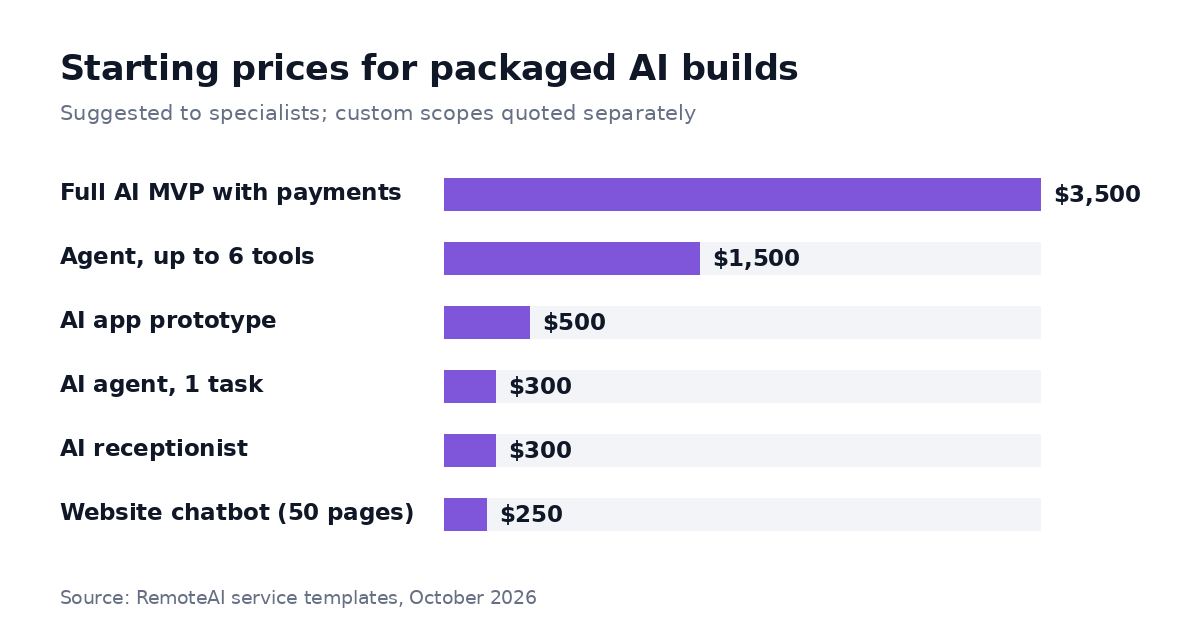
Starting prices RemoteAI suggests to specialists for packaged work, October 2026. Each specialist sets their own price. They are not what a custom project costs.
If you prefer to pay by the hour, there is no standard rate either. Ask for the rate in writing and a cap per milestone, so the total cannot drift.
What drives the price up
The same "chatbot" can be a small package or a large custom project. Here's what makes the difference:
- Number of systems to connect. A bot that only reads your help pages is simple. One that also checks orders in Shopify, opens tickets in Zendesk and updates HubSpot needs an integration for each.
- Your data. Clean documents in one place are cheap to use. Scattered PDFs, scanned files and outdated pages need cleaning before any AI can rely on them.
- Actions, not just answers. An agent that books, refunds or sends emails needs permissions, approvals and logs, because a wrong action costs more than a wrong answer.
- Personal or sensitive data. If the system reads customer, health or financial data, budget for a privacy review, access controls and the vendor's data processing terms.
- How sure you need to be. Testing on hundreds of real examples, measuring accuracy and handling edge cases can take a large share of a serious build.
- Who maintains it. Models, prices and your own processes change. Someone has to update prompts, data and connections.
In other words, ask what the system must do and what it must connect to, not only which model it uses.
What it costs to run each month
Model usage is the running cost that grows with traffic, billed per million tokens (a token is roughly three quarters of a word). Hosting and maintenance come on top, as the 12-month budget below shows. According to Anthropic's pricing page, Claude Sonnet 5.5 costs $2 per million input tokens and $10 per million output tokens, and Claude Haiku 5.5 costs $0.10 and $0.50 for prompts up to 100,000 tokens (checked November 11, 2026).
Here's a worked example, with assumptions you can change:
- A support chatbot handles 3,000 conversations a month.
- Each conversation sends about 4,000 input tokens (the question, the history and the retrieved help articles) and receives about 500 output tokens.
- Input: 3,000 × 4,000 = 12 million tokens × $2 = $24.
- Output: 3,000 × 500 = 1.5 million tokens × $10 = $15.
- Model usage: about $39 a month on Sonnet 5.5, or about $468 a year.
The same traffic on Haiku 5.5 would cost about $2 a month (12 million × $0.10 + 1.5 million × $0.50). If a small model answers your simple questions well, you can send only the hard ones to the larger model.
If your team already pays for a Claude plan that includes API credits, part of this usage may be covered: Claude Max includes $100 of API credits a month on the $100 plan, and Team plans include up to $500 a month of pooled API credits (Claude plans, checked November 11, 2026).
Voice agents add their own running costs: the voice platform and the phone provider bill per minute of call, on top of the model. Check the per-minute price on the platform you choose before you compare quotes.
A 12-month budget you can copy
The build is a one-off; the rest repeats. Here's a hypothetical first-year budget for the support chatbot above, connected to your helpdesk. The figures marked as assumptions are ours, not quotes:
| Item | First-year cost | Basis |
|---|---|---|
| Setup (build, integration, testing) | $6,000 | Assumed fixed quote for a custom chatbot connected to your helpdesk: build, integration, test set; excludes writing new content. Replace it with the quotes you receive |
| Model usage | $468 | Worked example above, Sonnet 5.5 prices |
| Hosting and a vector database | $600 | Assumption: $50 a month; check your provider's plan |
| Fixed fees (helpdesk add-on, monitoring) | Not included | Excluded from the total: check the plans you already pay for |
| Data work (cleaning help articles) | Included in setup | Assumption: content mostly up to date; your support lead keeps articles current, the developer re-indexes them under maintenance |
| Maintenance | $900 | Assumption: about 15% of the build a year |
| Your team's time | About 20 hours | Assumption: 9 hours of reviews and tests in the first month, then 1 hour a month for 11 months |
| Total | About $8,000 + fixed fees + 20 hours |
All figures in US dollars, before taxes.
Year two costs much less: usage, hosting and maintenance, so about $2,000 in this example, plus fixed fees and about 12 hours of your team's time. That's why a fixed-price first milestone matters: it caps the part of the budget that carries the most risk.
Budget mistakes to avoid
Overruns tend to come from a few gaps you can see in advance. Here's what to watch:
- Scoping "an AI assistant for everything". A vague goal has no finish line, so the bill keeps growing. Pick one task, such as "answer order-status questions", and add the next one after it works.
- No test set. Without 50–100 real examples and the answers you expect, nobody can say if the system works, and you pay for rounds of guessing.
- Paying by the hour with no milestone. Hourly work is fine for small changes. For a build, ask for a fixed price per milestone, each with a test you run yourself.
- Forgetting the running costs. Usage, hosting and maintenance repeat every month, as the budget above shows.
- Messy data discovered late. If your documents are outdated or scattered, say so in the brief. Cleaning them is cheaper planned than discovered.
How to get a reliable quote
A precise brief gets a precise price. Before you ask anyone, write down:
- The one task the system must do, with three real examples of input and expected output.
- The systems it must read from or write to, and who can give access.
- Where your data lives and how up to date it is.
- What "good enough" means: for example, "answers 80% of order-status questions correctly, hands the rest to a person".
- Your budget range and timeline.
Then ask each candidate for a first milestone with a fixed price and a test you can run yourself. Our guide on how to hire an AI engineer lists the interview questions that show who has shipped similar systems, and our article on AI agents for business explains which tasks agents handle well.
Next steps
Pick one project, write the five-line brief above, and get two or three quotes against it. Comparing quotes for the same brief tells you more than any price list.
Ready to start? Post your project with that brief, or browse AI agent developers and OpenAI API developers to see who has built similar systems.
Sources: RemoteAI service templates (suggested starting prices), October 2026; Anthropic API pricing (checked November 11, 2026). Budget items marked as assumptions are illustrative, not quotes.