An AI agent development company builds software where a language model decides what to do next and acts in your tools: it reads a request, calls your CRM or helpdesk, checks the result and keeps going until the task is done. Choosing one comes down to three things: a clear task, a test before launch, and a builder who can show an agent they shipped.
The choice matters because the field is full of noise. In a June 2025 press release, Gartner predicted that over 40% of agentic AI projects will be canceled by the end of 2027, due to escalating costs, unclear business value or inadequate risk controls. According to the same release, only about 130 of the thousands of agentic AI vendors are real. That's why this guide starts with the task and the test, and only then with the vendor.
Agency or freelancer?
Both build the same kind of agent, so the difference is the team around it. Here's how they compare:
| Freelance AI agent developer | AI agent development company | |
|---|---|---|
| Best for | One agent, one task, a clear owner on your side | Several agents or departments, or a team needed at once |
| Who does the work | The person you interviewed | A team; ask who exactly |
| Price | One person's time | A team's time, plus project management |
| Contract | Simple, milestone-based | Company contract, often required by procurement |
| Risk | Capacity: one person | Ask who works on your project and whether the work is custom |
In other words, start with the scope. A support-triage agent or a lead-qualification agent is a scope one experienced developer can take on. A program with several agents sharing tools and permissions, a security review and audit logs is where an agency's extra roles pay off.
What it costs
A custom agent has no standard price. It depends on how many tools the agent uses, how big the test set is, where a person approves its actions and how it is monitored. The closest reference is a packaged agent. These are the starting prices RemoteAI suggests to specialists for a packaged custom AI agent in its service templates (October 2026):
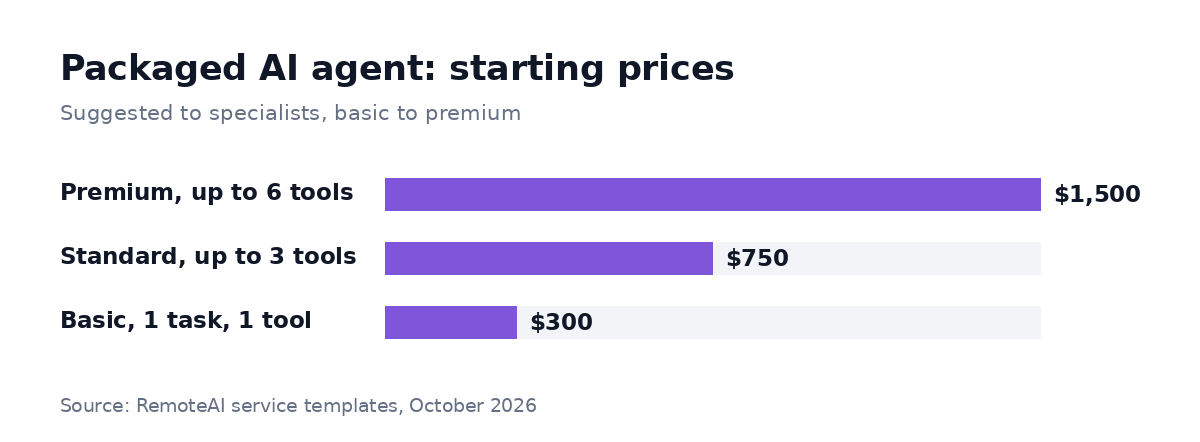
Starting prices RemoteAI suggests to specialists for a packaged AI agent, October 2026. Bigger or custom scopes are quoted separately.
- Basic, $300 (5 days): one agent for one task, one tool connection and a video handover.
- Standard, $750 (10 days): one agent with up to 3 tools, a human approval step and testing on your real data.
- Premium, $1,500 (15 days): a multi-step agent with up to 6 tools, monitoring and error alerts, and 2 weeks of support.
These packages fit a small, well-defined task. A production agent with memory, retrieval over your documents and a full evaluation set, or several cooperating agents with shared permissions, a security review and audit logs, is custom work with no standard price. There is more to build and test, so it costs more than a package. Ask each builder for a fixed quote per milestone, with the deliverables and the test written down, and compare agency and freelancer quotes on the same scope, line by line.
The build is not the only cost. Budget for model usage (billed per token), hosting and any tool subscriptions, someone to prepare and update the test cases, and your team's time to approve and review the agent's work. Our guide to AI agents for business has a 12-month budget example built on these packaged starting prices.
What a good proposal includes
Ask every candidate for the same items, so you can compare them line by line:
- The task, in one sentence, and the list of actions the agent may take. For example: "read new support tickets, tag them, draft a reply, and refund orders under $50 only after a person approves."
- What the agent is not allowed to do. Read-only access where possible, no payments or deletions without approval.
- A test set and a pass/fail number. Fifty to a hundred real past cases with the answer you'd accept, and the score the agent must reach before it goes live. Our AI proof of concept guide explains how to build one.
- Human approvals for risky actions, and what happens when the agent is unsure.
- Monitoring: cost per run, success rate, and an alert when something fails.
- Milestones with payments tied to results, not hours.
- Ownership: the code, prompts and evaluation set belong to you, in your repository.
If a proposal skips the test set or the limits, it's selling a demo, not an agent, because nothing in it tells you when the agent is good enough to go live.
Eight questions to ask on the first call
Here are the questions that separate builders from resellers:
- "Show me an agent you shipped that is still running." Ask what it does, how many runs a month, and what went wrong in the first weeks.
- "What happens when the agent is wrong?" You want a concrete answer, such as a confidence threshold that hands the case to a person.
- "Does this task need an agent at all?" Anushree Verma, Senior Director Analyst at Gartner, put it plainly: "Many use cases positioned as agentic today don't require agentic implementations." A good builder will tell you when a simple automation is enough.
- "Which framework, and why?" LangGraph, CrewAI, the OpenAI or Anthropic SDKs, or plain code. Any can work; the reason matters more than the name.
- "How will you test it before launch?" Listen for real cases and a number, not "we'll try it."
- "What will one run cost us?" Model calls add up when an agent loops. A builder who tracks cost per run will tell you.
- "Who will work on it?" With an agency, ask for the names and meet them.
- "What do we get at the end?" Code in your repository, documentation, and a handover session.
Red flags
Watch for these signs of what Gartner calls agent washing, the rebranding of existing products, "such as AI assistants, robotic process automation (RPA) and chatbots, without substantial agentic capabilities":
- A chatbot sold as an agent. If it only answers questions and never acts in your tools, it's a chatbot. That may be what you need, at a chatbot price.
- No limits, no approvals. An agent that can do anything in your systems on day one is a risk, not a feature.
- A fixed platform fee before scoping. You should know the task before you know the price.
- No examples from production. Demos are easy; agents that run for months are not.
- Vague ownership. If the prompts and code stay on the vendor's platform, leaving costs you a rebuild.
What we see on RemoteAI
On October 26, 2026, 421 of the 3,480 approved public profiles on RemoteAI mention AI agents or agentic work in their headline or description, and 332 list AI agents as a skill. Among the frameworks and protocols, 120 profiles name LangGraph, 16 name CrewAI, 15 name the Model Context Protocol (MCP) and 6 name AutoGen.
Method: approved public RemoteAI profiles counted on October 26, 2026; a profile counts when its headline or description mentions AI agents, agentic work or the framework name (MCP: "Model Context Protocol" or "MCP server"), or when it lists the "AI agents" skill.
For you, that means agent builders are not rare, but a profile can name a framework without a shipped agent behind it. Ask every candidate the first question above, and give more weight to one shipped agent than to a long list of frameworks.
How to start
Pick one task that repeats often and that someone on your team can check, such as triaging support tickets or qualifying inbound leads. Write the proposal checklist above as a one-page brief, attach 50 to 100 real past cases, and send it to two or three builders. Ready to test one task? Post the project with that brief, or browse AI agent developers and contact them directly. If the task turns out to be a fixed sequence of steps with no decision in it, an automation specialist may build it for less.
The short version
Choose the builder after you define the task, not before. A freelancer suits one agent with a clear owner; an agency suits several agents or teams at once. A packaged agent starts at $300 to $1,500 in the prices RemoteAI suggests to specialists (October 2026); anything bigger has no standard price, so get a fixed quote per milestone. Ask to see an agent that is still running, insist on a test set and limits, and keep the code and prompts in your own repository.
Sources: Gartner press release, June 25, 2025 (40% cancellation prediction, agent washing, about 130 real vendors, Anushree Verma quote). RemoteAI service templates (suggested starting prices), October 2026. RemoteAI figures: approved public profiles whose headline or description mentions AI agents or each framework (MCP counted as "Model Context Protocol" or "MCP server"), and profiles listing the "AI agents" skill, counted October 26, 2026. The example task is illustrative.