An AI proof of concept is a small, time-boxed build that tests whether AI can do one specific task on your real data well enough to justify a full project. It works when four things are fixed before anyone starts: the task, a set of real examples, a pass/fail number and a budget with an end date.
That last part matters more than the model you pick. According to a Gartner press release of July 29, 2024, at least 30% of generative AI projects would be abandoned after the proof of concept by the end of 2025. Gartner named four causes: poor data quality, inadequate risk controls, escalating costs and unclear business value. This guide shows how to scope one so you get a clear answer, whatever the answer is.
Proof of concept, pilot or MVP?
The three words get mixed up, and each one calls for a different test and budget. Here's how they differ:
| Stage | Question it answers | Who uses it | Typical output |
|---|---|---|---|
| Proof of concept | Can AI do this task well enough on our data? | Your team, on a test set | A score on real examples and a go/stop decision |
| Pilot | Does it work in our process, with real users? | A small group of real users | Usage, time saved, problems found |
| MVP | Will people use the first real version? | Real customers or staff | A working product to improve |
If you are not sure AI can do the task, start with a proof of concept. If you already know it can and the question is adoption, you need a pilot.
Step 1: Pick one task with a clear finish line
A proof of concept tests one task, not a vision. "AI for customer support" has no finish line; "answer order-status questions from our help center and order data" does.
Good candidates share three traits:
- They repeat often enough for savings to matter, such as hundreds of support emails or invoices a month.
- The right answer can be checked by someone on your team.
- The data exists today, in documents, tickets, a database or a shared drive.
Avoid two kinds of task for a first proof of concept: tasks where a mistake is costly and hard to catch, such as legal advice or payments, and tasks that depend on data you do not collect yet.
Step 2: Build the test set before the build
The test set is the heart of the proof of concept. Collect 50–100 real examples of the task, each with the answer you would accept. For example, 80 past customer emails and the reply a good agent sent, or 100 invoices and the fields your team typed into the accounting system.
Write it down before the developer starts. A test set chosen after the demo can flatter the demo.
Step 3: Set the pass/fail number in advance
Decide what "good enough" means, in numbers, with the people who will use it. Here are examples of bars you can set:
- Accuracy: "Correct answer on at least 85 of 100 test questions; every wrong answer flagged for a person."
- Time: "Drafts a reply in under 30 seconds that an agent sends with light edits at least 7 times out of 10."
- Cost: "Costs less than $0.05 per document in model usage."
- Safety: "Never sends money, deletes data or emails a customer without approval."
Pick one main number and one or two guardrails. If the result lands just under the bar, you will be tempted to move it: agree in advance what happens in that case.
Step 4: Cap the budget and the calendar
A proof of concept should be cheap to stop. Ask for a fixed price, a fixed end date and a deliverable you can run yourself: the test results on your examples, the code, and a short note on what it would take to go further.
Custom AI work has no standard price. As a reference, small builds with a fixed scope are sold as packages. The chart shows the starting prices RemoteAI suggests to specialists in its service templates (October 2026):
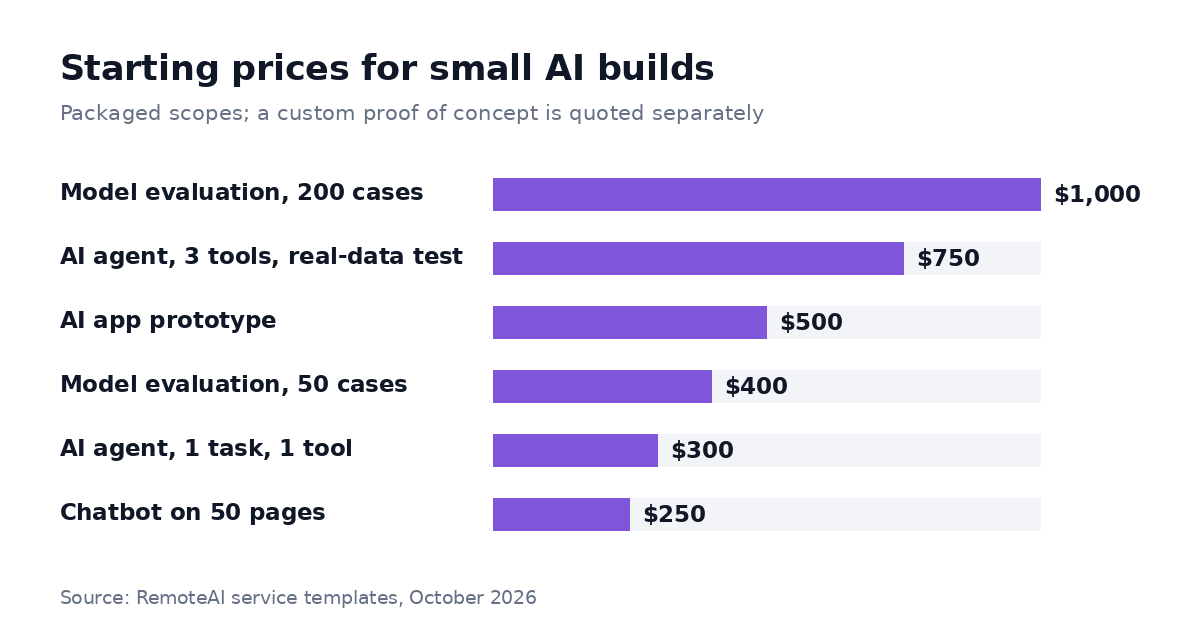
Starting prices RemoteAI suggests to specialists for packaged work, October 2026. Each specialist sets their own price, and these are not what a custom project costs.
A proof of concept on your own data and systems is a custom scope, so it is quoted separately. Send your brief and ask for a fixed quote with the deliverables in writing. Our guide to AI development cost shows what running the system costs afterwards, which belongs in your go/stop decision too.
A proof of concept brief you can copy
A one-page brief gets you comparable quotes. Replace the [fields]:
Task: [Answer order-status questions from customers by email.] Data: [Help center (120 articles), order database (read-only access), 6 months of past emails.] Test set: [80 past emails with the reply our team sent; we provide it on day one.] Pass/fail: [Correct and sendable reply for at least 70 of 80; any uncertain case handed to a person.] Guardrails: [No access to refunds; no email sent without approval during the test.] Deliverable: [Results on the test set, the code in our repository, a one-page plan for a pilot.] Budget and dates: [Fixed price, delivered by (date).]
Send the same brief to two or three specialists. If they ask questions about your data or your test set, that's a good sign.
The four reasons a proof of concept fails, and what to do
Gartner's four causes map to choices you make before the build. Here's how to handle each one:
| Cause named by Gartner | What it looks like | What to do before you start |
|---|---|---|
| Poor data quality | Outdated help articles, scanned PDFs, missing fields | Build the test set first; it shows the gaps early |
| Inadequate risk controls | The AI can act or answer without a check | Write the guardrails into the brief: approvals, read-only access, no customer contact during the test |
| Escalating costs | The scope grows, hours keep running | Fixed price, fixed end date, one task |
| Unclear business value | A demo that impresses but saves nothing measurable | Tie the pass/fail number to time or money: minutes saved per ticket, cost per document |
In other words, each of these four causes can be handled in the brief, before any code is written. A specialist who asks about your data and your success measure in the first call is addressing exactly these four points.
Step 5: Decide go or stop with real numbers
When the results arrive, compare them with the bar you set, then add the costs of running it for a year: model usage, hosting, maintenance and your team's time. Three outcomes are possible:
- Pass: move to a pilot with a few real users, with the same test set kept for regression checks.
- Close miss: fix the cause the results point to (missing data, unclear instructions) and run one more short round, only if the cause is clear.
- Fail: stop. You spent a capped amount to learn that this task, with this data, is not ready, which is cheaper than finding out after a full build.
Next steps
Pick the task, write the brief above and collect your test set this week. Building the test set can already show whether your data is ready.
Ready to run one? Post your proof of concept with the brief, or browse AI agent developers and RAG engineers who build first versions like this. Our guide on how to hire an AI engineer covers the interview questions to ask.
Sources: Gartner press release, July 29, 2024; RemoteAI service templates (suggested starting prices), October 2026. Pass/fail bars and the brief are illustrative examples.