Every company wants AI in its product or its operations, and most of them start the same way: by posting a job titled "AI engineer" and hoping the right person applies. The result is often hundreds of applications from people with very different skills — or a hire who is excellent at research when you needed someone to ship a feature.
This guide shows how to hire an AI engineer who fits the work you actually have. You'll see how to define the role, which skills to test, whether to hire full-time or freelance, what to ask in interviews and what it costs. It uses data from the 2,093 reviewed AI and machine learning engineers on RemoteAI.
Start with the problem, not the title
Start with the problem, because "AI engineer" is a broad title. Before writing a job post, write down in two or three sentences what the person will build in their first three months. For example:
- "A support assistant that answers customer questions from our help center and hands difficult cases to a human."
- "A pipeline that reads incoming invoices and fills our accounting software."
- "A recommendation model for our e-commerce catalog, retrained every week."
Each of these needs a different profile. The first is mostly retrieval and evaluation work with large language models. The second is automation and document processing. The third is classic machine learning with data pipelines. A clear first project attracts the right people and makes interviews much easier to run.
AI engineer, ML engineer or data scientist?
The titles overlap, but the center of gravity is different:
| Profile | Typical work | Hire when you need… |
|---|---|---|
| AI engineer | Products built on existing models: prompts, RAG, agents, evaluation, integration with your tools | A chatbot, assistant, document or workflow automation shipped to users |
| Machine learning engineer | Training, fine-tuning and serving models; MLOps | Your own models in production, retrained and monitored |
| Data scientist | Analysis, experiments, forecasting, statistical models | Answers and decisions from your data, not necessarily a product feature |
Many candidates cover two columns. Judge them by what they have shipped, not by the title on their CV.
The skills that matter — and how rare they are
Python is close to universal among AI engineers. The skills that separate profiles are the ones around large language models and production. Among reviewed AI and ML engineers on RemoteAI, they are far from universal:
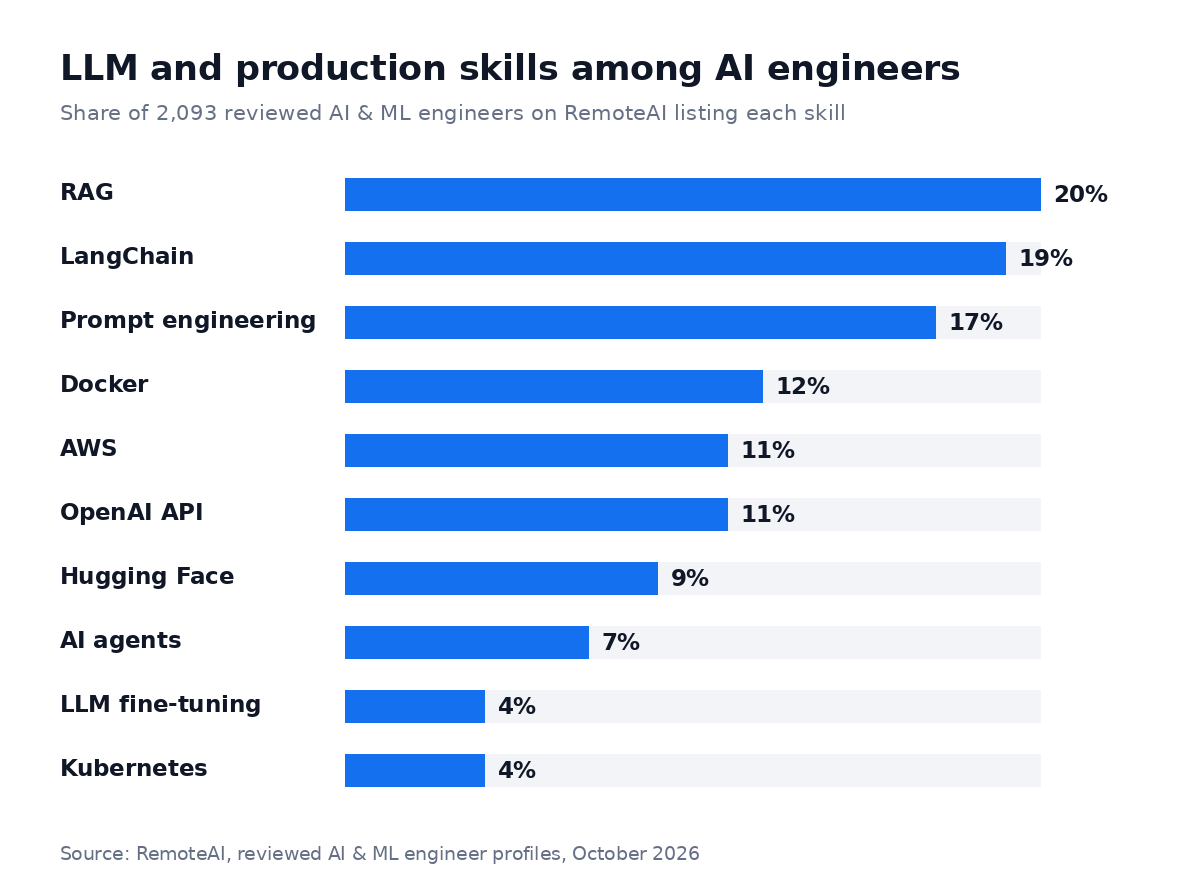
Only one in five lists retrieval-augmented generation (RAG); fewer than one in twenty lists LLM fine-tuning.
What this means when you hire:
- For assistants and chatbots on your own content, look for RAG, evaluation and one framework such as LangChain or LlamaIndex. Ask how they measured answer quality — that is the part most projects skip.
- For agents and automation, look for tool use, API integration and error handling. An agent that works in a demo but fails silently on the tenth request is the most common disappointment.
- For fine-tuning or your own models, the pool is much smaller. Search for it specifically and expect to pay more.
- For anything that goes to production, add Docker, a cloud provider and monitoring. Someone has to keep it running after launch.
Full-time, freelance or contract?
AI engineers are open to more than one way of working. On RemoteAI, most list several:
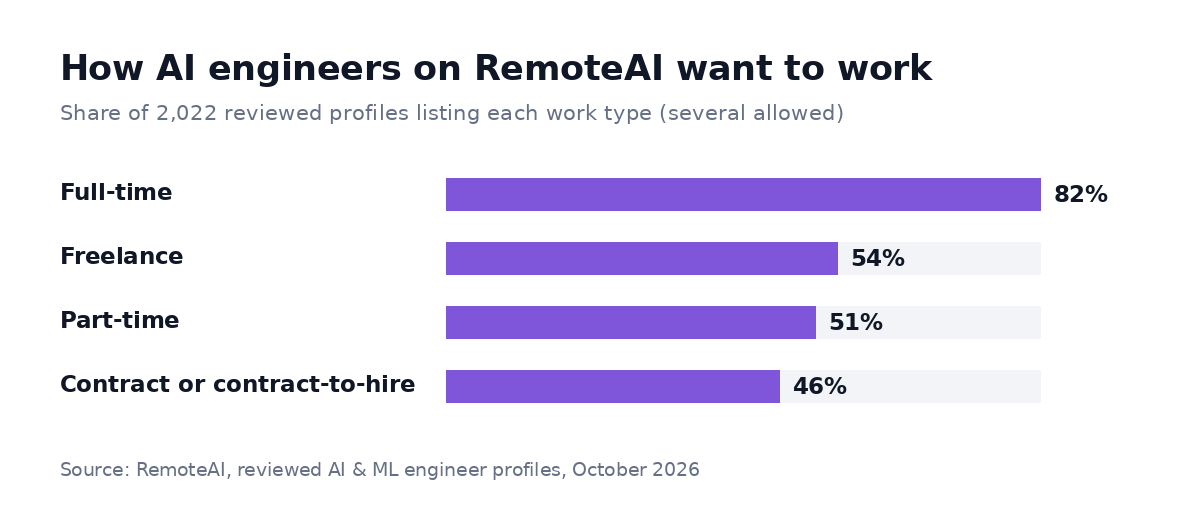
More than half are open to freelance work, and almost half to contracts — useful if you want to start with one project.
- Freelance or fixed project: best when you have one well-defined deliverable, or when you are still testing whether AI works for your business. You pay for a result and can stop after it.
- Contract or contract-to-hire: a few months of close work, with the option to make it permanent. A good way to judge someone on real work before a long commitment.
- Full-time: right when AI is part of your product and needs continuous ownership — improving models, monitoring quality, handling new use cases.
- Part-time: useful for maintenance and steady improvements after a project is live.
Starting with a contract and converting the best people is often the safest route for a first AI hire.
Where to find AI engineers
You'll find AI engineers on general job boards and on specialized platforms. General job boards bring volume but little filtering, while specialized platforms bring fewer, more relevant applicants. On RemoteAI you can post a job and see candidates ranked by how well their skills match it, or browse AI and ML engineers directly. For prompt and language work, see NLP and prompt engineers; for deployment and infrastructure, MLOps engineers.
Whichever channel you use, a precise job post does most of the filtering: the first project, the tools you already use, the data available and how success will be measured.
How to evaluate candidates
To evaluate candidates, look past the CV: a list of AI keywords says little. Three things say much more:
- Shipped work. Ask for one project that real users used, and what happened after launch: what broke, what they changed, which metric moved.
- A short practical exercise. Three to four hours at most, close to your real problem, and paid if it is longer. For example: build a small question-answering tool on five documents you provide and explain how to test it.
- A conversation about trade-offs. Good AI engineers talk about cost, latency, privacy and failure cases without being asked.
Interview questions that work
Ask questions that only someone who has shipped AI can answer:
- How would you measure whether our assistant gives correct answers? What would you do when it does not?
- Walk me through a project where the model worked in testing but failed in production. What did you change?
- When would you use RAG, and when would you fine-tune a model instead?
- How would you keep the cost per request under control as usage grows?
- What data would you need from us in the first week, and what would you build first?
- How do you handle personal or confidential data in a system that calls an external model?
Red flags
Be careful if you see any of these:
- Only notebooks and tutorials, nothing that ran for real users.
- No answer to "how do you know it works?" — no tests, no evaluation set, no metrics.
- Promising a fixed accuracy before seeing your data.
- Choosing tools before understanding the problem.
What does it cost to hire an AI engineer?
For a full-time hire, start from market data. The U.S. Bureau of Labor Statistics reports a median wage of $140,300 (May 2025) for computer and information research scientists, the closest official category; large tech companies pay well above that once stock is included. Our guide to the machine learning engineer salary compares the main sources and explains the gap.
For freelance and contract work, price depends on scope more than on hourly rates: a clearly defined project with one data source costs far less than an open-ended "add AI to our product". Ask for a fixed price per milestone, with the deliverable and the way it will be tested written down.
On RemoteAI, creating an account and browsing profiles is free. Companies that verify their website can post one job at a time for free; other options are on the pricing page.
A simple hiring plan
Here's a simple plan: about four weeks to hire, then a first month of work:
- Week 1: write the first project in three sentences, list your tools and data, decide full-time, contract or freelance.
- Week 1–2: publish the job post and contact the strongest matching profiles.
- Week 2–3: short calls, then a paid practical exercise for two or three finalists.
- Week 3–4: final conversation on the exercise, references, offer.
- First 30 days: one shipped milestone, measured — the best way to know you hired right.
More details on each step are in our guide on how to hire on RemoteAI.
The short version
Define the first project before the title, test the skills that project needs — usually retrieval, evaluation and production work rather than model training — and judge candidates by what they have shipped. Start with a contract or a fixed project if you are unsure, and keep the best people.
Ready to start? Post your AI engineer job or browse AI engineers now. More guides are on our articles page.
Sources: U.S. Bureau of Labor Statistics, Occupational Outlook Handbook — Computer and Information Research Scientists (May 2025 wages). RemoteAI figures: reviewed AI & ML engineer profiles, October 2026.