A forward deployed engineer (FDE), also called a forward deployed software engineer (FDSE), is a software engineer who works directly with a company's customers to make its product work in their world: their data, their systems, their rules. They write production code, but they write it next to the people who will use it.
To see what the job looks like today, we read 84 open forward deployed engineer job ads from 29 AI companies on 28 October 2026, imported by RemoteAI from the companies' own career pages. Here is what they do, what they ask for, what they pay and how much they travel.
What a forward deployed engineer does
A forward deployed engineer takes a product that works in general and makes it work for one customer. Every one of the 84 ads mentions customers. The typical week in these ads mixes three kinds of work:
- Building: integrations with the customer's data and tools, agents and retrieval pipelines, evaluation suites, deployment on the customer's cloud.
- Working with the customer: workshops to find the right use case, weekly reviews, on-site visits, training their team.
- Feeding the product team: turning what customers need again and again into features, so the next deployment goes faster.
For example, an FDE at an AI company might spend a month inside a bank's engineering team, connecting a model to its document systems, measuring answer quality, then handing the bank's engineers a system they can run.
FDE, solutions engineer or software engineer?
The title is new enough that companies use it differently. The clearest way to place it:
| Role | Writes production code | Time with customers | Measured on |
|---|---|---|---|
| Software engineer | Yes | Little | The product |
| Solutions or sales engineer | Some (demos, prototypes) | A lot, mostly before the sale | Deals won |
| Forward deployed engineer | Yes | A lot, from pilot to production | Customer deployments that work |
Palantir made the title known with its "forward deployed software engineers", who worked inside customer organizations. AI companies picked it up because getting a model to work inside a real business takes engineering, not only a demo. Read the responsibilities, not just the title: some companies use it for work closer to sales engineering, and some "solutions engineer" roles describe FDE work.
Forward deployed software engineer at Palantir
At Palantir, forward deployed software engineers (FDSEs) join a customer's team, often on site, and build on Palantir's platforms to solve that customer's problem. Palantir also has software engineers who build the core product, and the FDSE role is the customer-facing counterpart. Many people still search for the role through Palantir, but no Palantir ads are in our sample: the data below comes from the AI companies that now use the title.
Who is hiring forward deployed engineers
The 84 ads come from 29 companies. The ones with the most open roles that day:
- Databricks and OpenAI: 11 ads each.
- Cohere: 9.
- Cresta: 7.
- Cursor: 6.
- Snowflake: 5.
- Chalk: 4.
- Baseten, Cognition and ElevenLabs: 3 each.
You can see each company's current openings on its RemoteAI page, for example OpenAI, Databricks or Cohere, and all current forward deployed engineer jobs on one page.
These are mostly well-funded AI companies that publish their roles on public career boards. Consulting firms and large enterprises also hire FDEs, and they are not in this sample.
The skills the ads ask for
Python is the base: it is named in three out of four ads. After that, the ads ask for the skills you need to ship AI inside someone else's company:
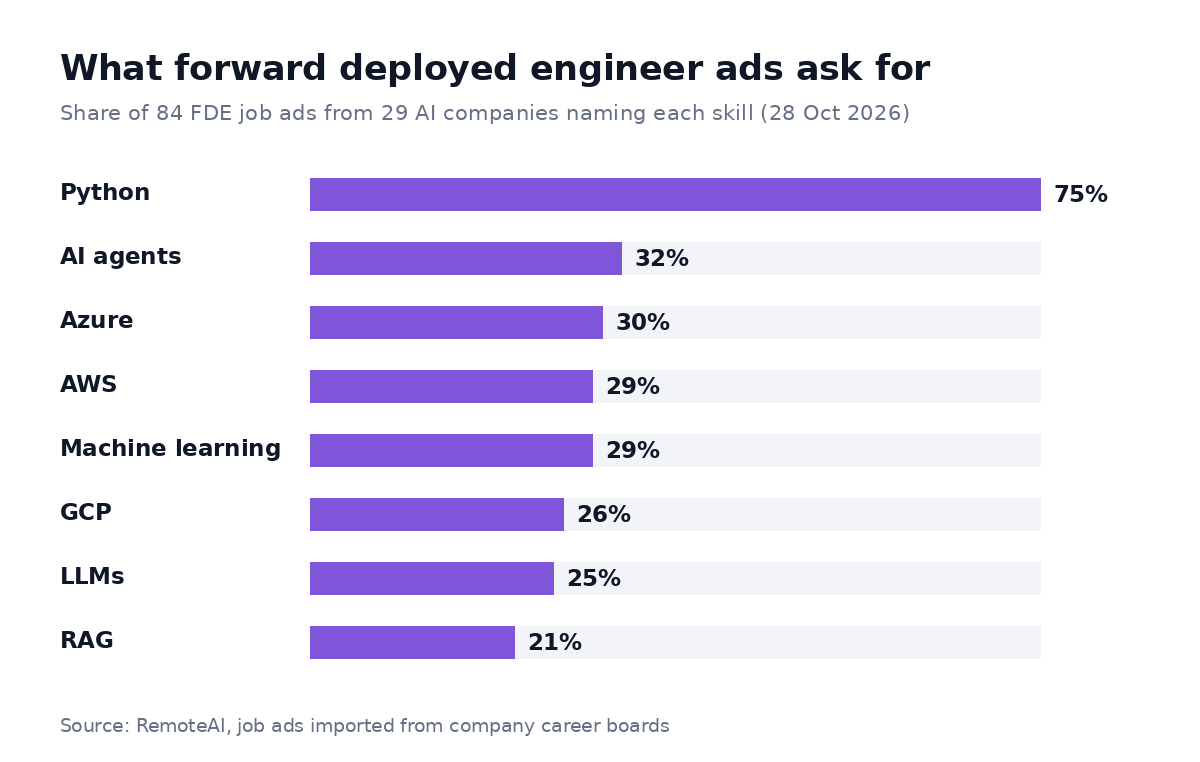
Skills named in each ad, as found by RemoteAI's skill tagging.
What stands out:
- Cloud, all three of them. Azure, AWS and GCP each appear in about a quarter to a third of the ads, because you deploy on whatever cloud the customer uses.
- Agents and retrieval. About a third of the ads name AI agents and a fifth name RAG: much of the work is connecting models to a customer's data and tools.
- Infrastructure basics. Kubernetes (17 ads), CI/CD (20) and Docker (10) show up because the system has to keep running after you leave.
Skills that are hard to tag also matter. 63 of the 84 ads mention communication, and 43 mention ambiguity: explaining technical trade-offs to non-engineers and scoping a problem nobody has defined yet are part of the job.
How much experience they ask for
Of the 84 ads, 59 state a number of years. Five years is the most common figure (20 ads), and 35 of the 59 ask for 3 to 5 years. Only 3 ask for 2 years or less.
That makes FDE a mid-career role in most of these companies. The usual path in is a few years as a software, ML or data engineer, ideally with some work that touched customers: an integration project, on-call for a customer-facing system, or consulting.
What forward deployed engineers earn
In the 26 ads from 12 companies that post a yearly range in US dollars, the average posted range is about $197,000 to $295,000. The lowest bottom is $120,000 and the highest top is $445,000. These are base salary ranges; equity and bonuses, where offered, come on top.
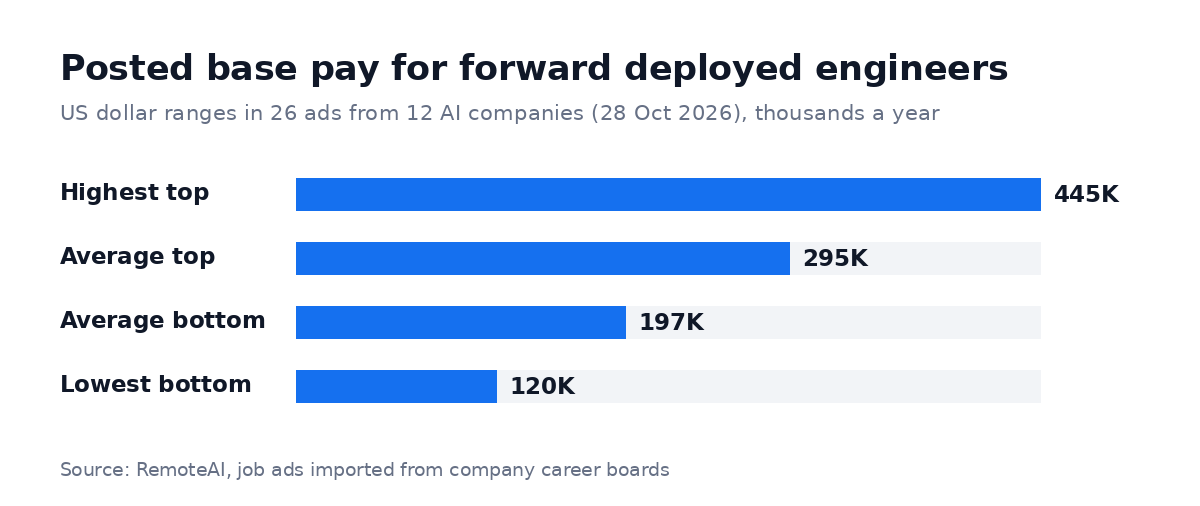
Average of the posted ranges. Only 12 companies post a US dollar range, so read it as a direction, not a benchmark.
Two things explain the spread:
- The company. Databricks' 8 ranges average about $179,000 to $246,000; OpenAI's and Snowflake's (3 ads each) average $238,000 to $370,000 and $268,000 to $385,000.
- The width of each range. On average, the top of a posted range is about 52% above the bottom, wider than the 45% we found for engineering roles in our machine learning engineer salary guide. The level you are hired at decides where you land.
How much forward deployed engineers travel
Expect travel. 42 of the 84 ads mention travel for the job, and 34 give a figure:
- About 20%: common in Databricks and Snowflake ads (Snowflake also says "at least 25% of your time onsite" in some).
- 20 to 40%: Cohere's ads.
- Up to 50%: most OpenAI ads; OpenAI also mentions 3 days a week in the office.
Remote is possible but not the norm: 35 of the 84 ads list a remote location. The others are tied to an office, from London, San Francisco and Menlo Park to Singapore, Washington DC, Ottawa and Japan.
Is the job right for you?
The job suits engineers who like seeing their code used the same week, and who do not mind context switching. It is harder if you want long stretches of focused work on one codebase, or cannot travel.
To get there:
- Ship something for a real user, even a small one: an agent that answers questions over a company's documents, with an evaluation set and a cost estimate.
- Show customer work on your profile: an integration, a migration, a deployment you owned with the people who used it.
- Learn one cloud well and be comfortable reading the other two.
On RemoteAI you can create a free profile so AI companies can find you, browse remote AI jobs, or follow the AI companies hiring right now. If you build AI agents, see how companies hire AI agent developers on RemoteAI.
Method: 84 open roles with "forward deployed" in the title, imported by RemoteAI from the career boards of 29 AI companies on 28 October 2026. Skills: RemoteAI's tagging of each ad. Experience: the first number of years written in the ad (59 ads). Pay: the 26 ads with a yearly range in US dollars. Travel: ads that mention travel for the job (benefit mentions such as "social travel stipend" excluded) and the percentages they state. Company averages mix all levels.
Sources: RemoteAI job data: open roles imported from the public job boards the companies run on Greenhouse, Lever and Ashby, taken October 28, 2026. No outside survey is used.