A machine learning engineer in the US earns a median of $140,300 in wages (BLS, closest official category) or $280,000 in total pay with stock and bonus (Levels.fyi). Both can be true. The difference comes from what is measured — base salary or total compensation — and who is counted: every employer in the country, or mostly large tech companies.
This guide uses two trusted sources, explains why they disagree, and shows what moves your pay up — with data from the 2,093 reviewed machine learning engineers on RemoteAI.
The short answer
Here's what the two main sources report:
- U.S. Bureau of Labor Statistics (BLS): machine learning engineers do not have their own official category. The closest one, computer and information research scientists, had a median annual wage of $140,300 in May 2025. The lowest 10 percent earned less than $82,200 and the highest 10 percent more than $230,630.
- Levels.fyi: self-reported total compensation for machine learning engineers in the US has a median of $280,000, with $200,000 at the 25th percentile, $386,000 at the 75th and $495,000 at the 90th.
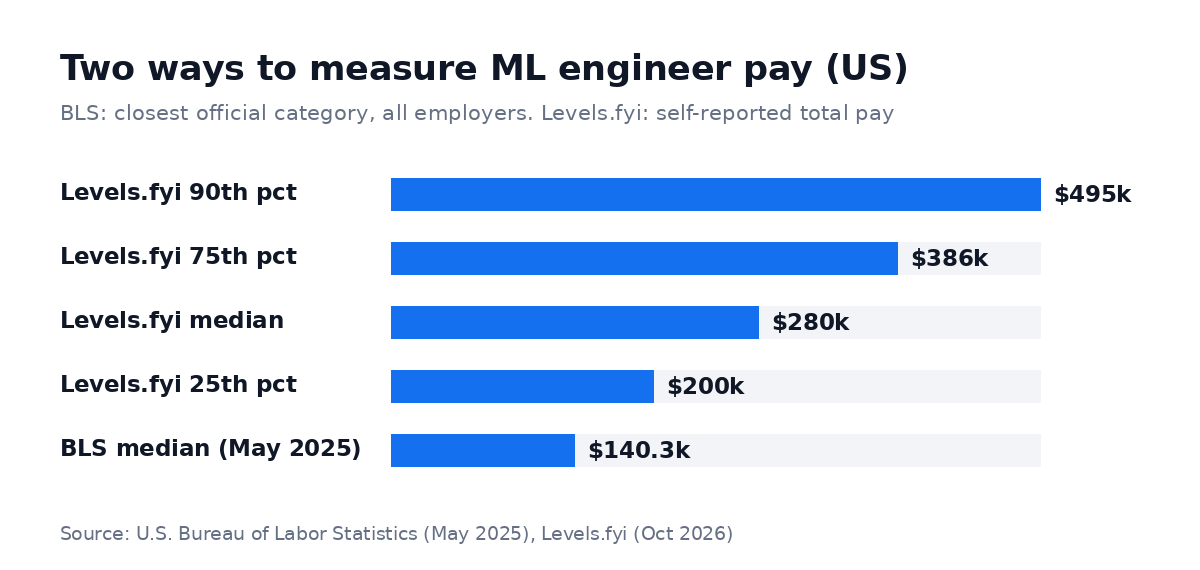
BLS counts wages across all employers; Levels.fyi counts total pay reported mostly by people at large tech companies.
Why the two numbers are so different
Three things explain the gap:
- Salary versus total compensation. BLS measures wages. Levels.fyi adds stock grants and bonuses, which at large tech companies can equal or exceed base salary.
- Who is counted. BLS covers every employer — universities, government, banks, small companies. Levels.fyi is filled in by its users, who are heavily concentrated at big tech firms and well-funded startups.
- Job titles. "Machine learning engineer" covers very different jobs, from building dashboards with a regression model to training and serving models used by millions of people.
That's why you should use both: the BLS figure is a realistic picture of the overall market, and Levels.fyi shows the top of it. In other words, the first tells you what most employers pay, the second what the best-paying ones offer.
Salary by level
Your salary as a machine learning engineer rises with each level, and scope matters more than years alone. As a guide to total pay by experience, Glassdoor data cited by Coursera (June 2026) runs from a median of $123,000 for 0–1 year to $158,000 at 4–6 years and $217,000 at 15+ years.
Here's what to expect at each level:
- Entry-level and junior: usually below the overall median. The biggest jumps come from moving to a company that pays in stock, or from owning one model end to end in production.
- Mid-level: around the market median, sometimes above it in high-paying cities. This is where specialization starts to matter more than titles.
- Senior: typically above the median, and at large tech companies often in the upper Levels.fyi range once stock is included.
- Staff and principal: set the technical direction for several teams; at the largest companies, total packages at these levels make up much of the top 10 percent.
On RemoteAI, the profiles show where competition is strongest: most reviewed machine learning engineers are early or mid-career.
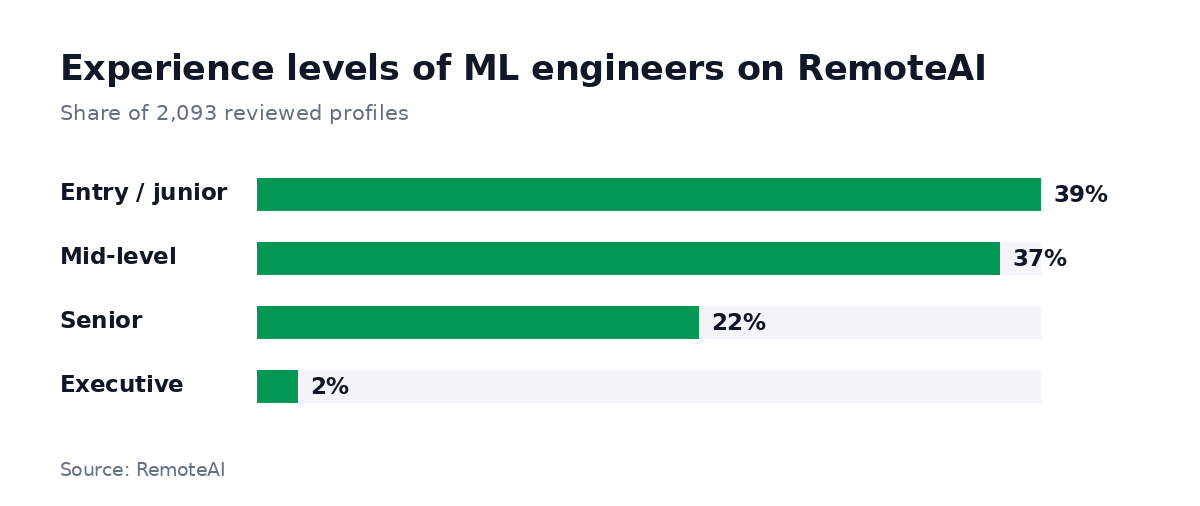
If you are senior, you are in the smaller group — something to remember when you negotiate.
Google, Meta, Apple, Amazon: why big tech pays more
Google, Meta, Apple and Amazon pay more mainly because of stock that vests over several years, plus annual refreshers and bonuses. Base salaries are closer to the rest of the market than the totals suggest, and the value of the stock moves with the share price.
Before you compare offers, convert every package to the same yearly terms. For example: base, stock value per year of vesting, bonus target, and the sign-on bonus spread over the first years. Levels.fyi publishes current packages by company and level, which is the most practical way to check a specific offer.
Location and remote work
Location changes your pay more than most engineers expect: it is highest where demand is concentrated, in the San Francisco Bay Area and New York above all. Many companies hiring remotely use location-based pay bands, so the same role can pay differently depending on where you live. For example, a company may pay its New York engineers a higher band than engineers in a lower-cost state for the same job. Others pay one band for a whole country or region.
Fully remote roles widen your options. You can work for a company in a high-paying market without moving, as long as you show the same results as someone in the office.
The skills that move pay up
The skills that move pay up are the ones around the model, not the training itself. Training a model is no longer rare; what companies pay more for is the work around it: putting models into production, keeping them reliable, and building with large language models. On RemoteAI, Python is the most common skill (75% list it), but production and LLM skills are much less common:
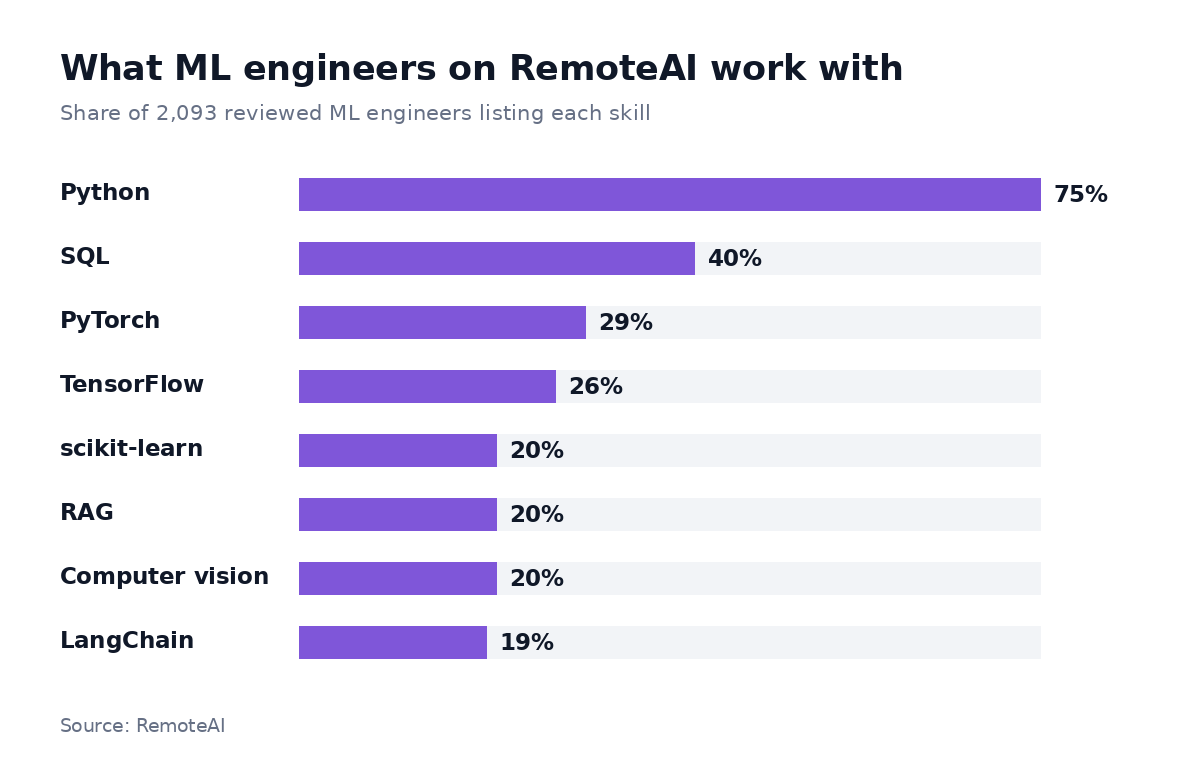
Only about one in five lists retrieval-augmented generation (RAG) or LangChain.
The skills worth adding if you want to earn more:
- MLOps and deployment: model serving, monitoring, retraining pipelines, cost control.
- LLM engineering: fine-tuning, retrieval-augmented generation, evaluation and guardrails.
- Data engineering basics: SQL and pipelines — models fail more often on data than on algorithms.
- Communication: explaining trade-offs to product and business teams is what separates senior from mid-level.
"AI engineer" or "machine learning engineer": does the title change the pay?
Since large language models arrived, many companies post roles as AI engineer rather than machine learning engineer. The work overlaps: both build systems that learn from data. The difference is usually the focus. AI engineer roles often center on building products with existing models — prompts, retrieval, agents, evaluation — while machine learning engineer roles more often include training and serving models.
The title matters less than the scope. Owning a model or an AI feature in production, with users and a budget depending on it, pays more. Running experiments that never ship pays less, whatever the job ad calls it. When you compare offers, read the responsibilities, not just the title.
Starting salary: how to land your first role
The first role is the hardest to get and the one that sets your starting point. What helps most:
- One project that runs in production, even a small one: a model behind an API, with monitoring and a short write-up of the results. It shows more than several notebooks.
- Solid basics: Python, SQL, statistics, and one framework (PyTorch or TensorFlow) used in depth rather than five used once.
- A clear specialization — computer vision, recommendation, NLP or LLM applications — so companies know where to place you.
- Adjacent roles as a way in: data analyst, data engineer or software engineer positions on teams that use machine learning often lead to an ML role within a year or two.
How to negotiate a better offer
To negotiate a better offer, prepare five things before the call:
- Anchor on total compensation, not base salary alone, and ask for the full breakdown in writing.
- Bring evidence of impact: a model you shipped, the metric it moved, the cost it saved. Numbers persuade more than titles.
- Use market data from both sources above — the BLS figure for the overall market, Levels.fyi for comparable companies.
- Negotiate the parts that flex: sign-on bonus, stock, level and title often move more easily than base salary.
- Get competing processes going at the same time; nothing raises an offer faster than a second one.
If you're unsure how to open, here is an example of wording you can adapt: "Based on Levels.fyi data for this level, I was expecting total compensation closer to [amount]. Is there room on the stock or the sign-on bonus?" It names a source, a number and the parts that usually flex.
Freelance and contract work
Freelance and contract work gives a machine learning engineer more control: you set your own rate, choose projects and work remotely. It also puts more weight on a strong profile and clear results, because clients compare you directly with others.
On RemoteAI you can create a profile once and get matched with AI roles and projects. You can also prepare fixed-price services on your profile, for example model evaluation, fine-tuning or a production pipeline, so companies see exactly what you offer and at what price.
The outlook
The outlook for machine learning engineers is strong: the BLS projects employment of computer and information research scientists to grow 22% from 2025 to 2035, much faster than the average for all occupations. Skills in production ML and large language models are where that demand is strongest.
Hiring? Compare these figures with the rates of reviewed machine learning engineers on RemoteAI and post a role.
Ready for your next role? Browse remote AI jobs, see machine learning engineer openings, or create your free profile so companies hiring machine learning engineers can find you. More guides are on our articles page.
Sources: Coursera, Machine Learning Engineer Salary (Glassdoor median total pay by experience, June 2026); U.S. Bureau of Labor Statistics, Occupational Outlook Handbook — Computer and Information Research Scientists (May 2025 wages, 2025–2035 projections); Levels.fyi — Machine Learning Engineer compensation (October 2026). RemoteAI figures: reviewed machine learning engineer profiles, October 2026.