A machine learning interview can test five things: the fundamentals, how you evaluate a model, how you would run one in production, your coding, and how you worked on past projects. You might wonder how deep to go on theory. For engineering roles, being able to explain a trade-off clearly matters as much as knowing the formula.
Below are 25 questions grouped by those five areas. For each one, you'll find what a strong answer covers, so you can practice saying it in your own words.
Fundamentals
Fundamentals questions check that you understand why models behave the way they do. Here are seven worth preparing:
- What is the bias-variance trade-off? A strong answer explains that bias is error from a model that is too simple and variance is error from a model too sensitive to the training data, then gives one way to reduce each (more features or a richer model; more data, regularization or simpler models).
- How do you detect and reduce overfitting? Compare training and validation performance, then name remedies: more data, regularization, early stopping, dropout, or a simpler model.
- What is the difference between L1 and L2 regularization? L1 adds the sum of the absolute values of the weights to the loss and can push some weights to exactly zero, which acts as feature selection; L2 adds the sum of their squares and shrinks all weights toward zero without removing them, which also helps with correlated features.
- Explain supervised, unsupervised and reinforcement learning. Give one business example of each, such as churn prediction, customer segmentation and a recommendation policy that learns from feedback.
- How does gradient descent work? Describe the loss, the gradient as the direction of steepest increase, and the update that steps the opposite way, scaled by the learning rate; then say why mini-batches are common (cheaper steps, useful noise).
- When would you use a tree-based model instead of a neural network? Tabular data of modest size, a need for quick training and some interpretability often favor gradient-boosted trees; images, text and audio usually favor neural networks.
- How would you evaluate a RAG system? Separate retrieval quality (are the right passages found) from answer quality (is the answer correct and grounded in those passages), and measure both on a fixed set of real questions.
Model evaluation
Evaluation questions check that you can tell whether a model is good enough for its job. These six are worth preparing:
- Precision or recall: which matters more? It depends on the cost of each error. For example, fraud screening may favor recall, while an automatic account block may favor precision.
- What does ROC AUC measure, and when can it mislead? It measures how well the model ranks positives above negatives across all thresholds. On very imbalanced data it can look high while the model still raises many false alarms, because the false positive rate is diluted by the large number of negatives; a precision-recall curve shows that cost directly.
- How do you validate a model on time-series data? Use time-based splits so the model never trains on the future, such as walk-forward (expanding or rolling window) validation, leave a gap when features use lags, and report results on the most recent period.
- What is data leakage? Give an example. Information from the target or the future slips into the features, such as a "refund issued" flag used to predict refunds. Another common case: scaling or imputing on the full dataset before splitting, so test statistics leak into training.
- How do you handle an imbalanced dataset? Choose a fitting metric first, then consider class weights, resampling (applied to the training data only) or threshold tuning, and check the result on an untouched test set.
- How would you compare two models fairly? Same data splits, same metric, enough test data, and a check that the difference is larger than the noise.
Production and system design
Production questions check whether your model would survive real users. They are central to engineering roles, so prepare these six:
- How would you deploy a model behind an API? Package the model and its preprocessing together, expose an endpoint, add input validation, logging and a fallback when the model fails.
- What would you monitor after launch? Input data drift, prediction distribution, latency, errors, model performance once true labels arrive, and the business metric the model is meant to move.
- When should a model be retrained? On a schedule, when monitored performance drops, or when the data changes; explain how you would test the new version before switching.
- Batch or real-time predictions? Batch is simpler and cheaper when results can wait; real time is needed when the answer must come during a user's action.
- How do you reproduce a training run? Version the data, the code and the configuration, fix random seeds where possible, and track experiments.
- Design a recommendation system for an online store. Start with the goal and the data you have, propose a simple baseline, then explain how you would improve it and measure success.
Coding and practical questions
Coding questions check that you can turn an idea into working code. Expect exercises like these three:
- Implement a train-test split and accuracy metric without a library. Shuffle with a fixed seed, split, then compare predictions to labels.
- Clean a messy dataset with pandas. Handle missing values, fix types, remove duplicates, and explain each choice rather than only writing code.
- Write a function that computes precision and recall. Count true positives, false positives and false negatives, and handle the case where a denominator is zero.
Behavioral questions
Behavioral questions check how you work with people and with uncertainty. Use situation, task, action and result to structure three stories:
- Tell me about a model that did not work as expected. Show how you found the cause and what you changed.
- Describe a time you explained a model to a non-technical person. Focus on the decision they had to make.
- What project are you most proud of, and why? Pick one you can explain from data to deployment.
For example, a short answer to question 23 might sound like this: "Our churn model scored well offline but missed real churners. I found that a key feature was only filled in after customers had left, so I removed it, retrained, and set up a weekly check of feature freshness." Treat it as an example of the structure, not a script.
What to prepare, according to the profiles on RemoteAI
On RemoteAI profiles, production skills are listed less often than model skills, so they help you stand out. We looked at the 172 confirmed profiles on RemoteAI whose headline says machine learning engineer or ML engineer:
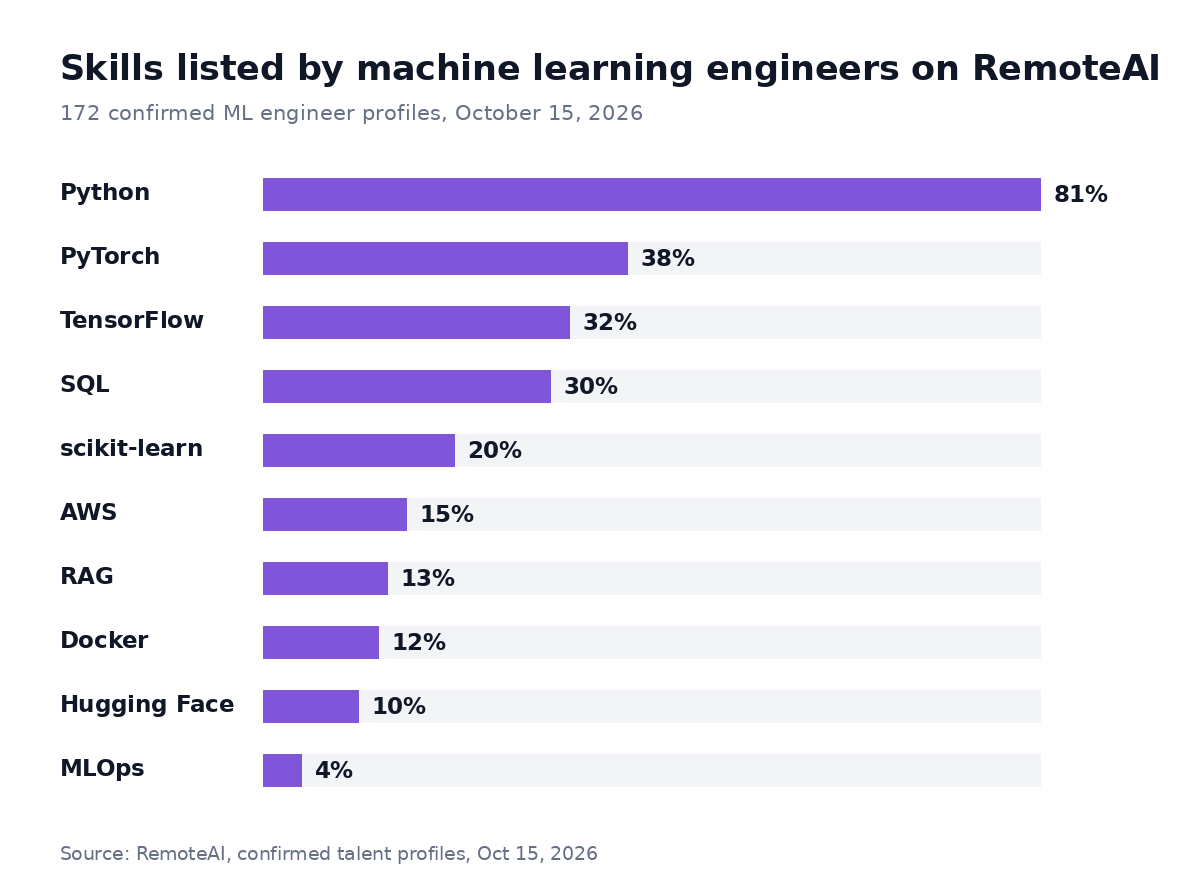
Method: confirmed RemoteAI talent profiles whose headline contains "machine learning engineer" or "ML engineer", counted on October 15, 2026; each share is the number of those profiles listing the skill. Skills are self-declared.
Two things stand out:
- Python is the shared language: 81% list it, so practice the coding questions in Python unless the job post names another language.
- Deployment skills are rarely listed: Docker appears on 12% of these profiles and MLOps on 4%. If you can answer questions 14 to 18 with an example from your own work, you stand out from most of the profiles we counted.
A one-week preparation plan
Here's an example plan if your interview is a week away. Adapt it to the role:
| Day | Focus | Done when |
|---|---|---|
| 1 | Fundamentals (questions 1–7) | You can explain each one out loud in two minutes |
| 2 | Evaluation (8–13) | You have an example of a metric choice from your own work |
| 3 | Production (14–19) | You can sketch how one of your models would be served and monitored |
| 4 | Coding (20–22) | You solved three exercises without looking up the syntax |
| 5 | Behavioral (23–25) | Three stories, each under two minutes |
| 6 | Mock interview | A friend or a recording, with notes on what to fix |
| 7 | Rest and review | You re-read your notes and the job post |
Your next step
Create your free profile so companies hiring machine learning engineers can find you, then browse machine learning engineer openings. To see what the role pays, read our guide to machine learning engineer salary, and if you're moving toward building with large language models, see how to become an AI engineer.
Sources: RemoteAI confirmed talent profiles (headline contains "machine learning engineer" or "ML engineer"), counted October 15, 2026. Questions and answer outlines are original; the preparation plan is an example.