To become an AI engineer, learn Python and software basics, learn to build with existing models (APIs, retrieval, evaluation), ship two or three projects that run for real, then apply to junior roles or small freelance projects. You might wonder whether you need a degree or years of math first. For many AI engineering roles, what you can build and explain counts as much as a diploma: read the requirements of each post.
This guide covers what AI engineers do, the skills that set profiles apart, three projects worth building, an example 6-month plan and how to land your first role.
What an AI engineer does
An AI engineer builds products and workflows on top of existing AI models. A typical week might include connecting a model to a company's documents, writing and testing prompts, building an agent that uses tools, and measuring whether the answers are good enough to ship.
The title overlaps with nearby roles, so it helps to see the differences:
| Role | Main work | Typical tools |
|---|---|---|
| AI engineer | Products built on existing models: retrieval (RAG), agents, evaluation, integration | Python, model APIs, LangChain or LlamaIndex, vector databases |
| Machine learning engineer | Training, fine-tuning and serving models | PyTorch, TensorFlow, MLOps tools |
| Data scientist | Analysis, experiments, forecasting | Python, SQL, statistics |
| Prompt engineer | Writing and testing prompts, often as part of an AI engineer's job | Model APIs, evaluation sets |
Read the responsibilities in each job post rather than the title: two "AI engineer" ads can describe very different work.
The skills that set AI engineers apart
Python is listed by 78% of the AI engineer profiles we counted. It's expected, not a differentiator. We looked at the 204 confirmed profiles on RemoteAI whose headline says AI engineer, LLM engineer or generative AI engineer:
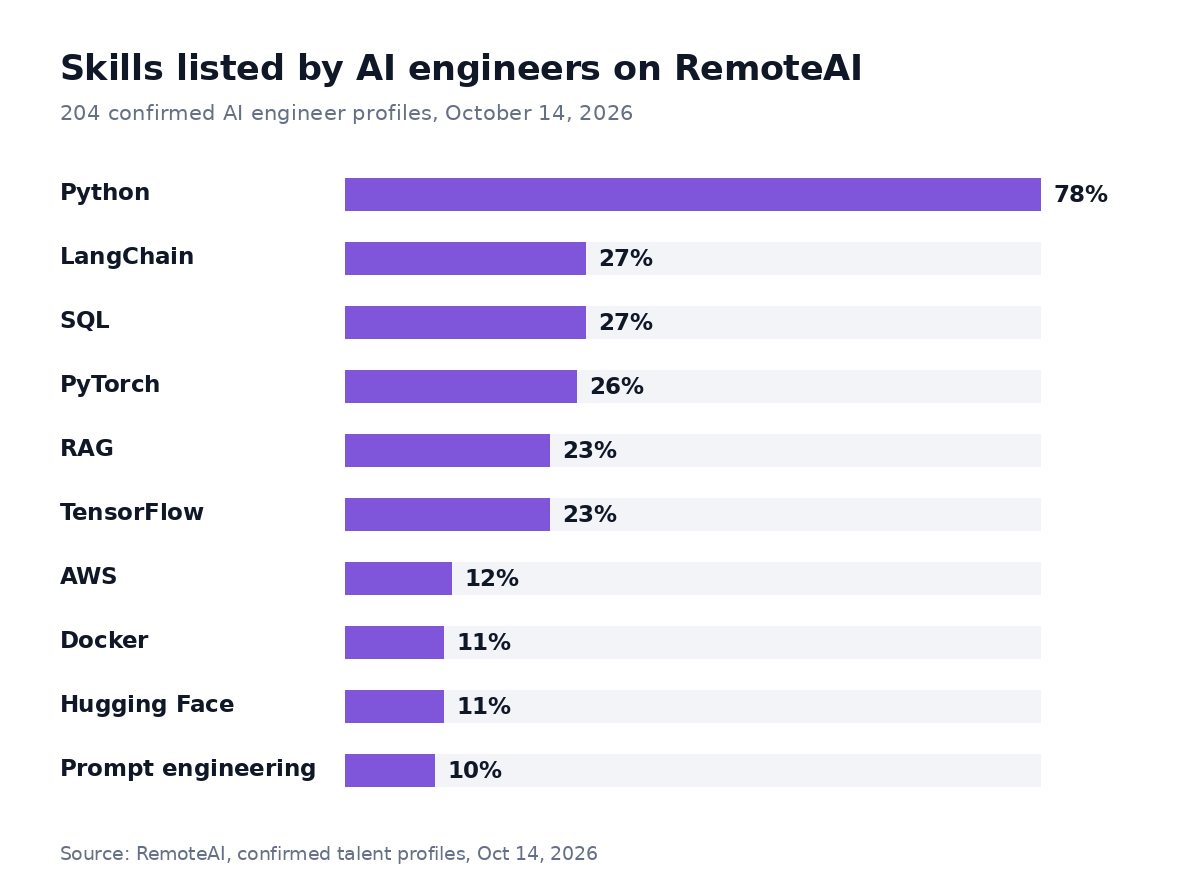
Method: confirmed RemoteAI talent profiles whose headline contains "AI engineer", "LLM engineer" or "generative AI engineer", counted on October 14, 2026; each share is the number of those profiles listing the skill. Skills are self-declared.
What this means for you:
- Python and SQL are the base. Expect to use both in almost every project.
- Retrieval (RAG) and a framework such as LangChain are each listed by only about one profile in four. They are worth learning early: the first two projects below use them.
- Deployment skills such as Docker (11%) and AWS (12%) appear on about one profile in ten. They show you can put something in front of users, not just run it in a notebook.
- Evaluation is not among the ten most-listed skills, yet it answers the question every AI project faces: how do you know the answers are right?
Three projects that show you can ship
Build projects that run and that you can explain from start to finish. Each one below covers a different part of the job:
- A question-answering assistant on real documents. Take 20 to 50 public documents (a product manual, a set of policies), build retrieval over them, and answer questions with citations. Write down how you tested it: for example, "30 test questions, 26 answered correctly with the right source."
- A small agent that uses tools. For example, an assistant that reads an email, looks up an order in a sample database and drafts a reply for a person to approve. Show what happens when a tool fails or the request is unclear.
- A deployed feature with a cost estimate. Put one of the above behind an API or a small web page, then write a short note on cost per request and how you would cut it. For example: "About 1,200 tokens read and 300 written per question. With Claude Haiku 5.5 ($0.10 and $0.50 per million tokens), that's about $0.0003 per question." A note like this shows you think about running costs, which clients and employers pay for every month.
For each project, publish the code, a two-minute demo video and a one-page write-up: the problem, your choices, how you tested the result, and what you would improve.
An example 6-month plan
Here's an example plan for someone who already codes a little and can study part-time. Adjust the pace to your starting point:
| Months | Focus | Done when |
|---|---|---|
| 1 | Python, Git, SQL, calling a model API | You can build a small script that calls a model and saves results |
| 2 | Prompts and evaluation | You have a test set of 30 examples and a score you can improve |
| 3 | Retrieval (RAG) and one framework | Project 1 answers questions with citations |
| 4 | Agents and tool use | Project 2 handles a failing tool without crashing |
| 5 | Deployment and cost | Project 3 runs behind an API, with a cost note |
| 6 | Portfolio and applications | Profile, write-ups and demos are live; you apply every week |
If you're starting from zero, add time for programming basics first. If you're already a developer, you can move faster through months 1 and 2.
How long does it take to become an AI engineer?
How long it takes depends on where you start and how many hours you can give each week. A working developer mostly adds new skills on top of what they know: model APIs, retrieval and evaluation. Someone new to programming first needs Python and the basics of software, which adds months. Measure progress by projects shipped rather than by courses finished: the example plan above ends with three working projects, not a certificate.
Mistakes that slow you down
Watch for four common traps:
- Collecting courses instead of shipping. One finished project teaches more than five half-watched courses.
- Skipping evaluation. Without a small test set, you can't tell whether a change made the answers better or worse.
- Building only in notebooks. Put at least one project behind an API so others can use it.
- Copying tutorial projects as they are. Change the data, the use case or the tools, so the project shows your own choices.
Can you become an AI engineer without a degree?
Yes, for many roles, because AI engineering is judged on shipped work. Some employers still ask for a degree in computer science or a related field, so check the requirements of the roles you target. Where a degree is listed as "preferred" rather than required, a strong portfolio and clear write-ups give you a real case to apply. If you need paid AI work while you learn, evaluation and annotation projects are open without a degree; our guide on whether data annotation is legit explains what they pay and how to spot fake offers.
How to land your first AI engineering role
Start where your projects are most relevant, and apply steadily rather than in bursts:
- Target junior and "AI-adjacent" roles. Software, data or automation roles on teams that use AI are one way in: you build AI features on the job. Open AI automation jobs are a good place to look for them.
- Take small freelance projects. A paid project for a real client, even a small one, is strong proof in your next interview.
- Tailor each application. Mention the one project closest to the job, and the result you measured.
- Prepare for practical interviews. Expect questions on how you evaluate answers, handle failures and control costs.
More than a third of these profiles are entry-level: on RemoteAI, 36% of the 204 AI engineer profiles are entry-level, 40% mid-level, 23% senior and 1% executive (same method and date as above). Shipped projects are what separate one junior profile from the next.
Your next step
Create your free profile with your projects, so companies hiring AI engineers can find you, and browse AI engineer openings or all remote AI jobs. To see the other side, read how companies hire an AI engineer, which AI skills are in demand, and what a machine learning engineer earns. Before you apply, run your CV through our guide to an AI resume checker.
Sources: Claude API pricing, checked October 14, 2026; RemoteAI confirmed talent profiles (headline contains "AI engineer", "LLM engineer" or "generative AI engineer"), counted October 14, 2026. The 6-month plan is an example, not a guarantee of timing.