An AI consulting business helps companies decide where AI is worth using and then puts it to work. In practice, small and mid-size companies buy three things: an assessment of where AI fits, the implementation of one or two use cases, and training so their team can use the tools. Start with one of these, at a fixed price, for one kind of client.
The hard part is turning what you know into an offer a business owner can say yes to in one call.
Here's what this guide covers:
- The three offers companies buy, and what each one includes
- A seven-step plan to go from skills to a first paying client
- Where clients come from, and how to price your first projects
- The mistakes that keep new consultants stuck
What an AI consulting business sells
An AI consulting business sells decisions and results, not tools. The client wants to know where AI saves time or money in their company, what it costs, and who will make it work.
Here are the three offers that cover most of that demand:
| Offer | What the client gets | How it is usually priced |
|---|---|---|
| AI readiness assessment | A few interviews, the top use cases with their costs, tool recommendations, a short roadmap | Fixed price per package |
| AI implementation | One or two use cases built and running: an automation, a chatbot, AI inside the client's tools | Fixed quote per milestone, after the assessment |
| AI training for teams | A live session for one team, with exercises on their own tasks | Fixed price per session; more teams cost more |
For a reference point on the assessment, RemoteAI suggests these starting prices to specialists who sell it as a package (October 2026):
- Basic, $300: two interviews, the top five AI opportunities, a one-hour review call.
- Standard, $900: up to five interviews, a scored opportunity map, a 90-day roadmap with costs.
- Premium, $2,000: a full assessment, an AI policy for the team, a two-hour team workshop.
These are starting prices for a small, fixed scope. A 200-person company, several departments or the build itself are quoted separately, because a five-person agency and a large company do not need the same review.
Who is looking for AI consulting
Business owners search for help in plain words. DataForSEO data for the US in October 2026 shows about 720 monthly searches for "ai consulting business", 320 for "ai business consulting" and 170 for "small business ai consulting", with a keyword difficulty of 11 or lower for the three we checked.
That last search matters most for a new consultant. Small businesses have the problem (repetitive work, slow answers to customers, reports done by hand) but no one in-house to fix it. They also decide fast, because the owner is often the buyer.
How to start an AI consulting business in 7 steps
To start an AI consulting business, pick one client type and one offer first, then build proof around it. Here's the order that works:
- Pick a niche you already understand. Accounting firms, clinics, real estate agencies, e-commerce shops. Your past job or clients are the best starting point, because you already speak their language.
- Package one offer. For example: "AI readiness review for accounting firms: three interviews, your top three time savers with costs, and a 30-day plan." One sentence, one price, one deliverable.
- Build a sample deliverable. A redacted report or a template with fictional numbers shows the client exactly what they will get. It answers "what do I get for $1,500?" before they ask.
- Get one case study. Do your first assessment at a lower price for a business you know, in exchange for a short written result you can share, such as "found 12 hours a week of manual invoice work."
- Set your prices. Price each package by its scope: interviews, deliverables, follow-up calls. Charge per project, not per hour: clients compare outcomes, not your time.
- Choose your tools. Most small-business work uses off-the-shelf tools: ChatGPT or Claude for teams, workflow tools like n8n or Zapier, and AI features already inside the client's software. Recommend what the client can maintain.
- Write the follow-up offer. Every assessment should end with a priced next step, such as "build the invoice automation, $3,500." That is often where the larger project comes from.
How to price your first projects
Price your first projects per outcome, with a clear scope. A fixed price is easier for a small business to approve than an hourly estimate, and it rewards you for working efficiently.
The starting prices RemoteAI suggests, from $300, are where a new seller with no reviews can begin. Once you have delivered a few projects and can show results, you can charge more. Here's an example of how a three-package offer can look at that stage:
- Starter ($1,200): two interviews, top three use cases with time saved and cost, a one-page plan.
- Standard ($2,500): four interviews, a process review, a scored list of use cases, a tool shortlist and a 30-day plan.
- Plus ($4,000): the Standard package and a live one-hour workshop for the team on the first use case. Aim it at larger clients, who have more people to interview and train.
These are example packages, not RemoteAI rates. Adjust them to your niche, and write in each one what is not included, so the scope does not grow quietly.
Where your first clients come from
For most new consultants, the first clients are people who already know their work. Without a network, expect this to take longer. Here's where to look, in order:
- Your network. Former employers, clients and colleagues. A short message describing your one offer, with the sample report attached, is enough to start conversations.
- Content about one niche. One LinkedIn post a week about a real problem in your niche ("how a 6-person accounting firm cut month-end reporting by a day") tends to bring better-fit calls than general AI news, because the reader recognizes their own problem.
- Partners. Web agencies, accountants and IT providers get asked about AI by their clients and often prefer to refer someone than to learn it.
- Marketplaces and job boards. Companies post AI projects with a clear scope and budget. On RemoteAI you can create a profile and apply to open AI jobs. You can also prepare a consulting service on your profile. Companies cannot order services on RemoteAI yet, so treat it as a draft of your offer to reuse in proposals.
What we see on RemoteAI
On RemoteAI, many specialists describe themselves as strategists, and very few mention workshops, one of the hands-on formats listed on our training hire page. We counted approved profiles whose description mentions each term.
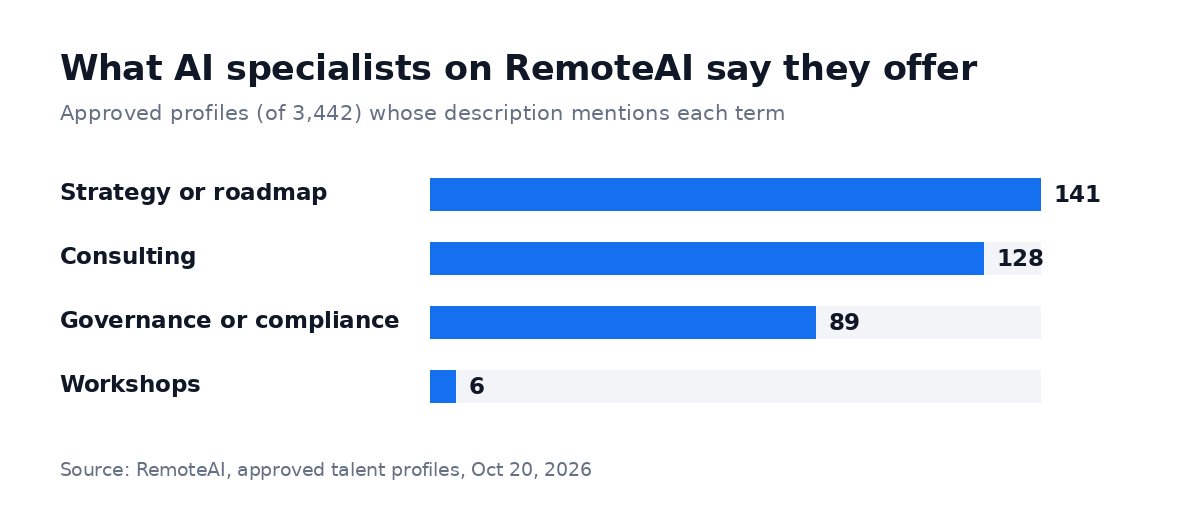 Approved RemoteAI talent profiles (3,442) whose description mentions each term, counted on October 20, 2026. "Consulting" counts consult, consultant and consulting; one profile can mention several terms.
141 profiles mention strategy or roadmaps and 128 mention consulting, but only 6 mention workshops. Few profiles describe a practical session where a team leaves with its own prompts and one working automation. This is a word count in profile descriptions, so some specialists may run workshops without saying so. Our guide to the AI skills in demand shows which technical skills sit behind these offers.
Five mistakes that keep new AI consultants stuck
These are the mistakes that most often delay a first client:
- Selling "AI strategy" in general. A business owner cannot picture it. Sell a named deliverable with a price.
- No niche. "I help businesses with AI" competes with everyone. "I help clinics answer patient questions faster" competes with almost no one.
- Recommending tools the client cannot run. A custom system with no one to maintain it fails after you leave. Start with tools the team already uses.
- Hourly pricing on fuzzy scope. It invites haggling and endless extra calls. Fixed packages with a written scope protect both sides.
- No next step. An assessment that ends with a report and no priced follow-up leaves money and results on the table.
The short version
An AI consulting business starts with one offer for one kind of client: an assessment, an implementation or a team training, at a fixed price. Price each package by its scope, build one case study, and end every project with a priced next step. Small businesses are searching for this help, and few consultants make it simple to buy.
Ready to put your first offer in front of companies? Create your RemoteAI profile, describe the one problem you solve with a real result, and look at open AI jobs for projects that fit it.
Sources: RemoteAI service templates (suggested starting prices), October 2026. Search volumes: DataForSEO, US, October 2026. RemoteAI figures: approved talent profiles counted October 20, 2026.