Every list of "AI skills in demand" says the same thing: learn Python, learn machine learning, learn prompting. That advice is not wrong — it is just not useful, because everyone already follows it.
The more useful question is: which skills do companies ask for that few people have? That is where interviews come easier and where pay is negotiated up.
RemoteAI sees both sides of the market. So we compared them: the skills listed in 419 live AI job posts from 76 employers, and the skills listed by 3,363 reviewed AI professionals on the platform (October 2026). Here is what the data says.
What AI job posts ask for
Python is still the entry ticket: 60% of AI job posts ask for it. After that, the list is less about models and more about building and running systems.
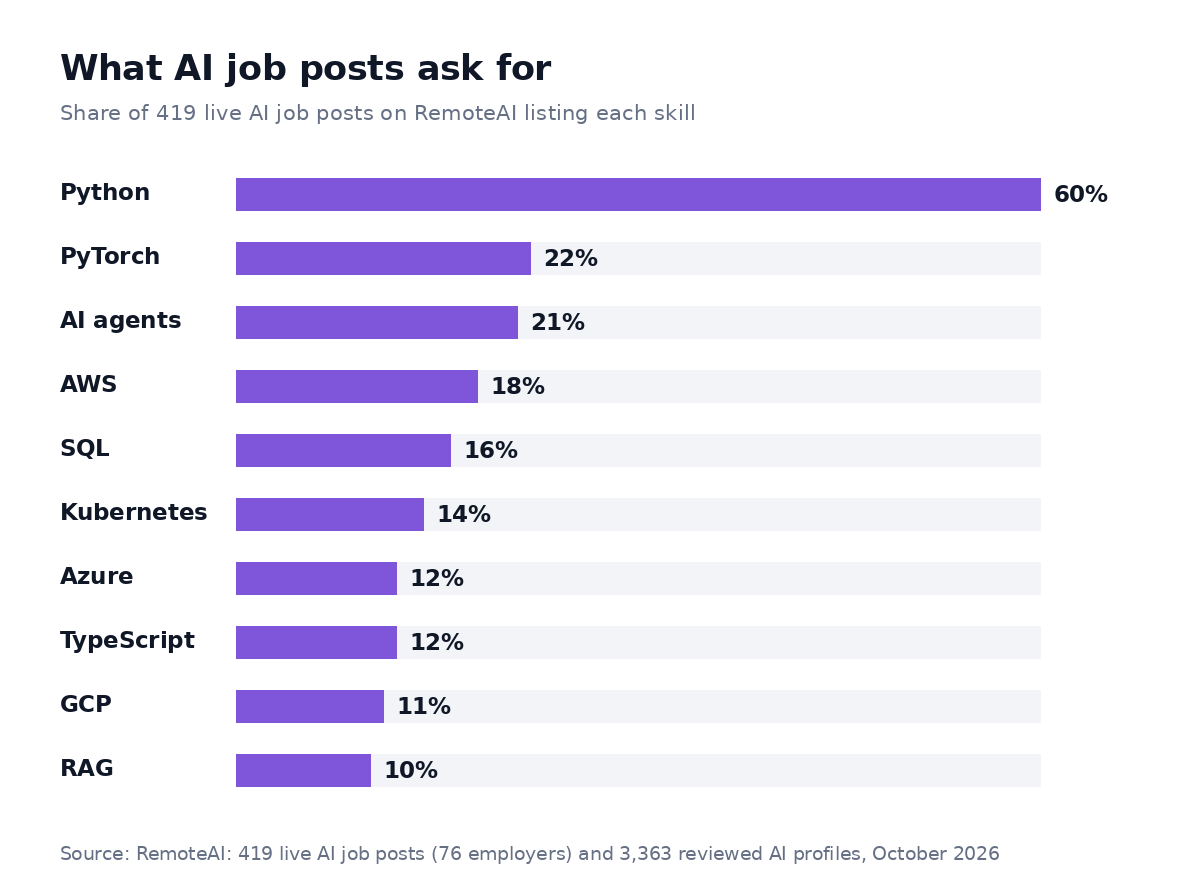
Share of 419 live AI job posts on RemoteAI listing each skill.
Three things stand out:
- AI agents (21%) are already asked for in one AI job post out of five — almost as often as PyTorch.
- Cloud skills are everywhere: AWS (18%), Azure (12%) and GCP (11%) together appear more often than any model framework except PyTorch.
- Infrastructure is part of the job: Kubernetes appears in 14% of AI job posts. Companies want people who can ship and run what they build.
The skills in short supply
Now compare demand with supply. For each skill, we divided the share of job posts asking for it by the share of AI profiles listing it. A score of 1 means the market is balanced; 10 means the skill appears ten times more often in job posts than on profiles.
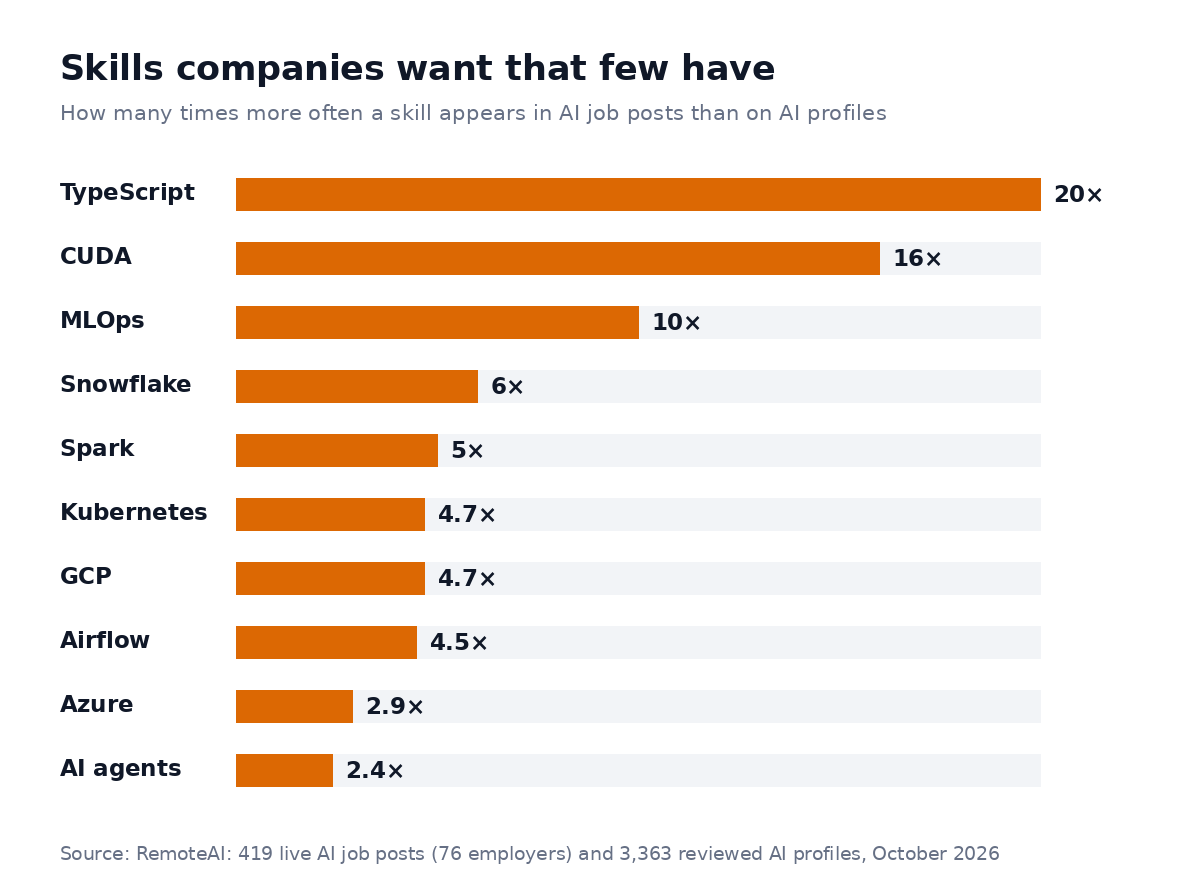
How many times more often each skill appears in AI job posts than on AI profiles.
The shortages fall into three groups:
- Production and infrastructure — MLOps (10×), Kubernetes (4.7×), CUDA (16×). Training a model is common; deploying it, scaling it and keeping it fast and affordable is not. CUDA in particular points to GPU optimization work that very few profiles mention.
- Data platforms — Snowflake (6×), Spark (5×), Airflow (4.5×). AI systems run on data pipelines, and companies struggle to find AI people who are also comfortable with the data stack.
- Product engineering — TypeScript (20×). AI features end up in web products. AI professionals who can also build the interface and the API around a model are the rarest profile in our data.
Cloud platforms (GCP 4.7×, Azure 2.9×) and AI agents (2.4×) complete the list: demand is growing faster than the number of people who list them.
The crowded skills
The opposite list matters too. Some skills are listed by many more professionals than the jobs that ask for them:
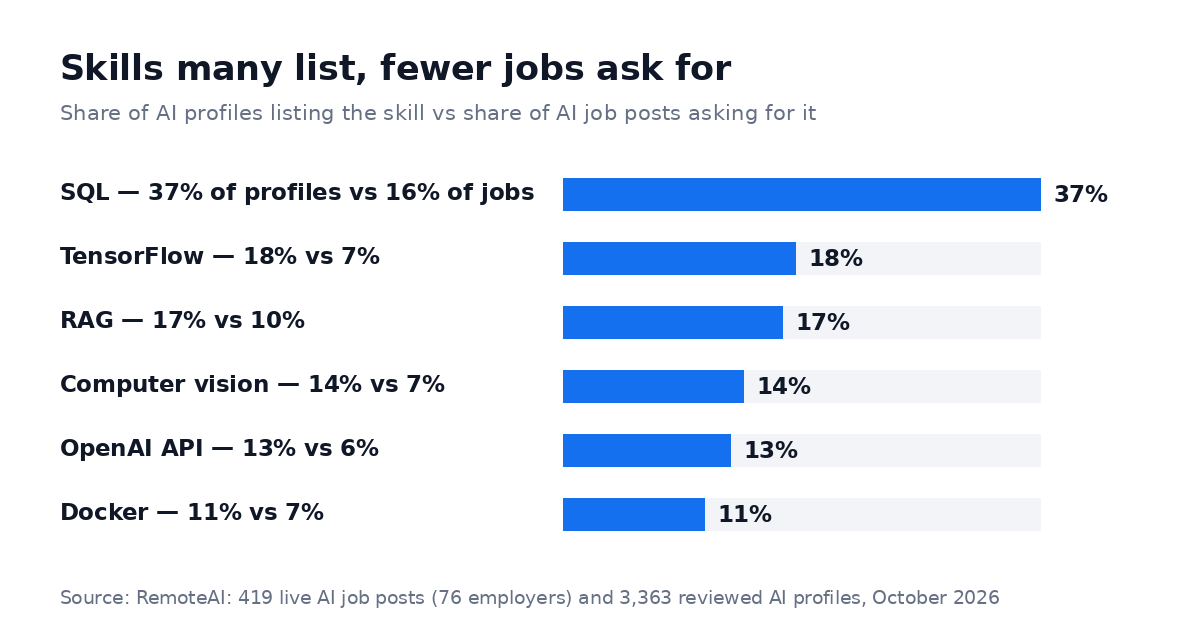
Share of AI profiles listing each skill (bar) compared with the share of AI job posts asking for it.
These are not useless skills — SQL is still asked for in one AI job post out of six. But they no longer make a profile stand out:
- TensorFlow is listed on 18% of profiles but asked for in 7% of job posts. PyTorch is the framework companies ask for most.
- RAG and the OpenAI API are now common: many professionals have built a retrieval chatbot. On their own they are not a differentiator; combined with evaluation, deployment and cost control, they are.
- Computer vision is listed twice as often as it is asked for — strong for specialized roles, crowded as a general label.
What this means if you work in AI
- Pair what you know with what is scarce. If you build RAG systems, add deployment: containers, Kubernetes and one cloud. If you train models, add MLOps — monitoring, retraining pipelines, serving.
- Learn the data stack around AI. Spark, Airflow or Snowflake turn an ML profile into one that can own a system end to end.
- Consider the product side. TypeScript plus AI is the most under-supplied combination in our data, and it suits the growing number of AI features shipped inside web products.
- Write it on your profile. Many professionals use these tools but do not list them. Companies search by skill — a skill you do not list does not exist for them.
A 90-day plan to close the gap
Pick the path closest to what you do today. Each one adds the scarce skills from the data above to skills you already have.
If you build LLM apps (RAG, chatbots, agents):
- Month 1: package one of your projects with Docker and deploy it on AWS, GCP or Azure, with logs and a cost estimate per request.
- Month 2: add an evaluation set and automatic checks, so you can show that answers stay correct after each change.
- Month 3: turn it into an agent that calls real tools (a CRM, a database, an API) with error handling — and write the result up on your profile.
If you train models (ML engineer, data scientist):
- Month 1: serve one model behind an API and monitor its latency and accuracy.
- Month 2: build a retraining pipeline with Airflow or a similar scheduler, reading from a real data source.
- Month 3: run it on Kubernetes or a managed ML platform, and document how you would scale it.
If you are a web developer moving into AI:
- Month 1: add an AI feature to a TypeScript app — search, summaries or a support assistant — using a model API.
- Month 2: make it reliable: streaming, retries, rate limits, and a fallback when the model fails.
- Month 3: measure quality and cost, and present the feature with real numbers.
In every case, the proof matters more than the certificate: a project that runs, with numbers, beats a course list.
Our guide to the machine learning engineer salary shows how much production skills weigh on pay.
What this means if you hire
The shortages above are where hiring takes longest. Two practical consequences:
- Do not wait for a perfect match on scarce skills like MLOps or CUDA. Hire a strong engineer with the closest experience and budget time to learn.
- Write the job post around the work, not a long list of tools. Candidates with the rare skill often skip posts that ask for ten others they do not have.
You can browse MLOps and AI infrastructure specialists on RemoteAI, or see our guide on how to hire an AI engineer.
How we measured
- Job posts: every live AI job post on RemoteAI in October 2026 — 419 posts from 76 employers, mostly imported from employers' own career pages. Demo listings were excluded. A post counts as "AI" when its title names an AI, machine learning, data science or related role.
- Profiles: the 3,363 reviewed, public AI profiles on RemoteAI. Skills are the ones professionals list themselves.
- Shortage score: share of job posts listing a skill divided by the share of profiles listing it. Broad labels such as "machine learning" or "LLM" are tagged differently on posts and profiles, so we left them out of the comparison.
- Limits: this is one platform's view of the market, and self-listed skills under-count what people can actually do. The direction of the gaps is the useful part, more than the exact ratios.
You are welcome to quote or republish these figures with a link to this page.
Find work that matches your skills
If you have one of the scarce skills above, now is a good time to show it. Browse remote AI jobs, see MLOps engineer jobs and machine learning engineer jobs, or create your free profile so companies searching for these skills can find you. More guides are on our articles page.
Source: RemoteAI — 419 live AI job posts (76 employers) and 3,363 reviewed AI profiles, October 2026.