The remote AI job market in November 2026 is mostly an engineering market. Of 1,903 remote-eligible roles open at 149 AI companies on November 2, 2026, only about 28% have AI, ML, LLM, agent or research words in the title. The rest are software, infrastructure and customer-facing engineers who build and ship AI products, and the skills their ads ask for are often not the ones AI talent lists first.
Most reports on the AI job market measure how AI changes jobs across the economy. This one counts something narrower that you can act on: the roles AI companies are hiring for right now.
If you are hiring for AI work, that is the market you compete in. This report shows you which roles AI companies open to remote candidates, which skills they name, and where ads and talent profiles disagree.
Key findings
Here's what you need to know from the count:
- Most roles are engineering roles. General software engineering is the largest group (22%), ahead of forward deployed and solutions engineering (13%) and infrastructure (12%).
- Python leads, cloud follows. Python appears in 49% of ads, AWS in 26% and Kubernetes in 25%. "AI agents" (22%) is named more often than LLMs (15%).
- Hiring is senior. Of the 898 titles that state a level, 96% are senior or above.
- Remote stays within borders. About 62% of postings tie the role to the United States or the Americas.
- Ads and profiles point at different skills. Kubernetes is in 25% of ads but on 3% of 3,152 RemoteAI talent profiles.
Which roles AI companies hire for remotely
AI companies hire mostly software, infrastructure and customer-facing engineers when they hire remotely. We sorted the 1,903 postings into role families by keywords in the job title. Here are the families with enough postings to read:
| Role family | Share of postings | Companies |
|---|---|---|
| Software engineering | 22% | 86 |
| Forward deployed, solutions | 13% | 54 |
| Infrastructure, platform, SRE | 12% | 74 |
| Programs, operations, other | 11% | 67 |
| Research | 7% | 38 |
| AI and LLM engineering | 6% | 46 |
| Product management | 5% | 43 |
| Security | 5% | 40 |
| Machine learning engineering | 5% | 29 |
| Data science and data engineering | 4% | 44 |
Share of 1,903 remote-eligible postings at 149 AI companies by role family, from title keywords. RemoteAI, November 2, 2026.
Research, AI and LLM engineering and machine learning engineering together make up less than a fifth of these postings. Applied AI scientists and MLOps or inference roles add about 3% each.
That's why your search for "AI engineer" misses most of this market.
Take a hypothetical senior backend engineer at a model company. They may spend the whole week on inference costs, and you would never find them by searching for AI in the title.
The forward deployed engineer is the role to watch
The forward deployed engineer is the clearest new role in this data. The exact phrase appears in 88 titles at 31 different companies.
These engineers put a model or an agent into a customer's systems and bring what they learn back to the product team. A company that sells AI to other businesses will likely compete for this hire.
Counted with solutions architects and customer engineers, this family has 241 postings. That is more than research and machine learning engineering combined (229).
Our guide to the forward deployed engineer role covers what the job involves, the skills the ads name and the travel to expect.
What skills AI job ads ask for
AI job ads ask for Python first, then cloud and deployment skills. Python is named in 49% of the 1,903 postings, at 118 of the 149 companies, so no single employer drives it:
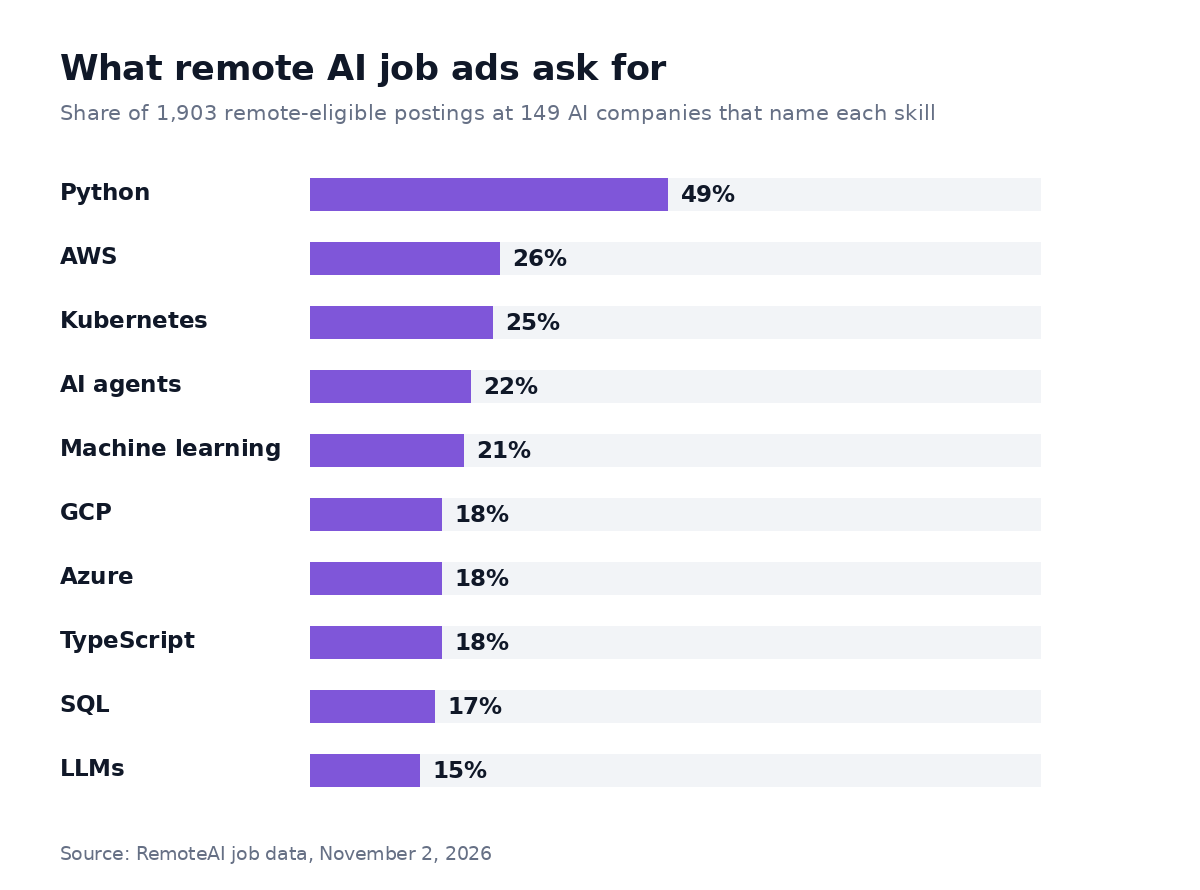
Share of 1,903 remote-eligible postings at 149 AI companies that name each skill in the title or description. RemoteAI, November 2, 2026.
Two things stand out in this list.
First, agents have become a line in the requirements. "AI agents" appears in 22% of ads, at 83 companies, more often than LLMs in general (15%).
Second, cloud work sits right behind Python. AWS, Kubernetes, GCP and Azure each appear in about a fifth to a quarter of ads, because these companies run models in production. If your role runs on one of them, you should say so.
The order shifts in the 524 ads with an AI or ML title. Python rises to 53%, machine learning to 33%, AI agents to 29%, LLMs to 28% and PyTorch to 21%.
Retrieval-augmented generation (RAG) and LLM fine-tuning each appear in about one in ten of these ads. Our October analysis of the AI skills in demand counted only posts with an AI or data title (419 posts from 76 employers), and Python reached 60% there. In this larger November count, with more company boards imported, Python is in 53% of AI-titled ads and 49% of all ads.
Who they hire: senior and full-time
AI companies hire senior people for remote roles. Just under half of the titles state a level, and among those 898 titles, 96% are senior or above.
Senior is the most common level (409 postings), then staff (271), then lead, principal and leadership roles.
Internships exist but are rare (34 postings), and junior or graduate titles are close to absent. Almost every posting is full-time: 1,876 of the 1,903.
In other words, a remote AI candidate at this level has options. They will compare your role with full-time offers from AI companies. If you can hire and train a mid-level engineer, say so in your ad: few of these ads are open to that level.
Where a remote AI hire can live
Remote in this market rarely means "from anywhere." The job board's location text usually says where the remote hire must live:
- United States or the Americas: about 62% of postings, at 114 companies.
- UK and Europe: about 15%, at 53 companies.
- Asia-Pacific: about 6%.
- Canada: about 3%.
- "Remote" with no region: about 4%.
Ads that say worldwide or global are rare and come from a handful of companies. If you can hire across countries, you have an edge most of these employers do not offer. Otherwise, name your countries or time zones.
What these roles pay, in short
Pay is published for about half of these roles, mostly US ones. Across 883 yearly US dollar ranges from 73 companies, the median low end is $200,000 and the median high end $285,000. Weighting each company once, the typical midpoint is about $222,000, because the biggest posters pull the posting median up.
Our AI engineer salary study breaks pay down by level, location and company.
The gap between job ads and talent profiles
The skills ads ask for most are often the ones talent profiles list least. We compared the ads with the skills on 3,152 public RemoteAI talent profiles.
The methods differ (words in an ad against skills people pick for their profile), so read the size of the gap, not the exact points:
| Skill | Share of job ads | Share of profiles |
|---|---|---|
| Kubernetes | 25% | 3% |
| GCP | 18% | 3% |
| Azure | 18% | 5% |
| AWS | 26% | 11% |
| AI agents | 22% | 11% |
| CI/CD | 15% | 6% |
| PyTorch | 11% | 23% |
| RAG | 6% | 19% |
| LangChain | 3% | 18% |
| TensorFlow | 3% | 21% |
| Prompt engineering | 3% | 23% |
Share of 1,903 remote-eligible job ads at 149 AI companies vs share of 3,152 public RemoteAI talent profiles that list each skill. November 2, 2026.
Ads lead on running systems: cloud platforms, Kubernetes, deployment pipelines and agents. Profiles lead on modeling and LLM tooling. Very few profiles list TypeScript, which appears in 18% of ads.
So what does that mean for you? The scarce person is not someone who knows another library.
You are looking for someone who combines Python and machine learning with cloud and deployment work, and can show a system they shipped and kept running.
What it means for you if you are hiring
If you are hiring for AI work, write the role around the problem and the stack, then screen for what candidates have run in production. Here's how to apply this data to your next role:
- Name the problem the person will own. "Build and run the retrieval pipeline behind our support agent, on AWS" tells a candidate more than "AI engineer, LLM experience a plus."
- List the stack they will actually use, cloud included. If the work runs on Kubernetes and GCP, say so. Those are the skills you will find least often on profiles.
- Search beyond the AI title. Platform, backend and forward deployed engineers often do the work you need. A platform engineer who ran GPU clusters, for example, may fit an inference role better than an AI generalist. Look at what they shipped, not at their job title.
- Say where the hire can live. If you can hire across countries or time zones, put it in the first lines; few competitors do.
- Ask for a system, not a list of libraries. In screening, ask: "Tell me about one model or agent you deployed. How did you monitor it, and what broke first?"
A common mistake is to copy the requirements of a large lab. If you need one agent in production, you do not need a research profile.
You need someone who has deployed and maintained a similar system, and you can check that in one call.
How we counted: methodology
This report uses 1,903 remote-eligible job postings live on RemoteAI on November 2, 2026. We import them from the public job boards (Ashby, Greenhouse, Lever and a few company career pages) of 149 AI, ML and data companies.
The postings were added to RemoteAI between August 4 and November 2, 2026, and a listing not updated at its source for 45 days is hidden.
Here's what this count covers and what it does not:
- Remote-eligible technical and product roles only. A role counts when the job board marks it remote-eligible. Sales, recruiting, legal, finance, marketing, HR and policy roles are filtered out by the importer. So this is not every job at these companies, and not every AI job on the market.
- A few employers weigh a lot. The ten largest employers, led by OpenAI, Snowflake and ClickHouse, account for 40% of postings. That's why we also give company counts.
- Skills count when the title or description names them, from a fixed list of about 90 skills with common aliases. Broad terms such as machine learning, LLMs or AI agents count only when named at least twice, so a company blurb does not count. A mention is not always a hard requirement. A company's own product in its own ads (Snowflake, Databricks) is not counted.
- Role families come from keyword rules on the title, first match wins. A manual check of 60 titles showed the rules are mostly right but imperfect, so the shares are indicative and rounded. AI training and annotation roles (59 postings) come from only 6 companies and are left out.
- Levels and region come from title keywords and from the job board's location text.
- Talent profiles are the 3,152 public RemoteAI profiles that list at least one skill: our own pool, not the whole market.
This is one snapshot, not a trend. Figures based on fewer than about 30 postings are described without a number or left out.
Next steps
Your next step is to write down the problem your AI hire will own and the stack it runs on, then compare it with the skills above.
If you need someone who has already shipped models in production, you can browse AI and machine learning engineers or AI agent developers and message a profile directly. Ready to reach candidates who know that stack? Post a job on RemoteAI with the stack and the region in the first lines.
Sources: public applicant-tracking job boards of 149 AI companies and 3,152 public RemoteAI talent profiles, counted by RemoteAI on November 2, 2026.