A good AI engineer job description says what the person will build, which skills the work really needs, and what you pay. Below is a template you can copy, and next to it what real companies write. On 28 October 2026 we read 204 AI and ML engineer job ads from 57 AI companies, imported by RemoteAI from their career pages.
The short version: name the product and the problem in the first lines, keep requirements to what the job needs, and post the range. Only 79 of the 204 ads post a yearly pay range in US dollars.
The template
Copy it, then replace everything in brackets. Aim for something a candidate can read in three minutes, about 600 to 700 words.
AI Engineer, [team or product]
[Company] builds [product] for [customers]. We are hiring an AI engineer to [the one outcome that matters most, for example "take our support agent from pilot to all customers"].
What you will do:
- Build and ship [feature, for example "retrieval and tool-calling for our support agent"] used by [who, how many].
- Design evaluations that tell us when a model or prompt change makes things better or worse.
- Put models into production: serving, monitoring, cost and latency budgets.
- Work with [product, design, customers] to turn vague requests into working features.
- [One responsibility specific to your team.]
What you need:
- [3–5] years building software, including at least one AI or ML feature in production.
- Strong Python. [PyTorch, or the framework you actually use.]
- Experience with large language models: prompting, retrieval (RAG), tool calling or fine-tuning.
- [One domain or infrastructure skill the job really needs, for example AWS or Kubernetes.]
Nice to have:
- [TypeScript, if engineers also touch the product front end.]
- [Experience in your industry.]
Pay and how we work:
- Salary: [$X – $Y] a year, plus [equity, bonus].
- [Remote within time zones X–Y / hybrid in city], [hiring steps and how long they take].
- How to apply: [link], and what to send (CV, GitHub, one project you shipped).
What 204 real ads ask for
Most AI engineer ads name the same short list of skills. Python leads, and nearly three in ten name PyTorch. The newer skill is building AI agents: it appears in 37% of the ads.
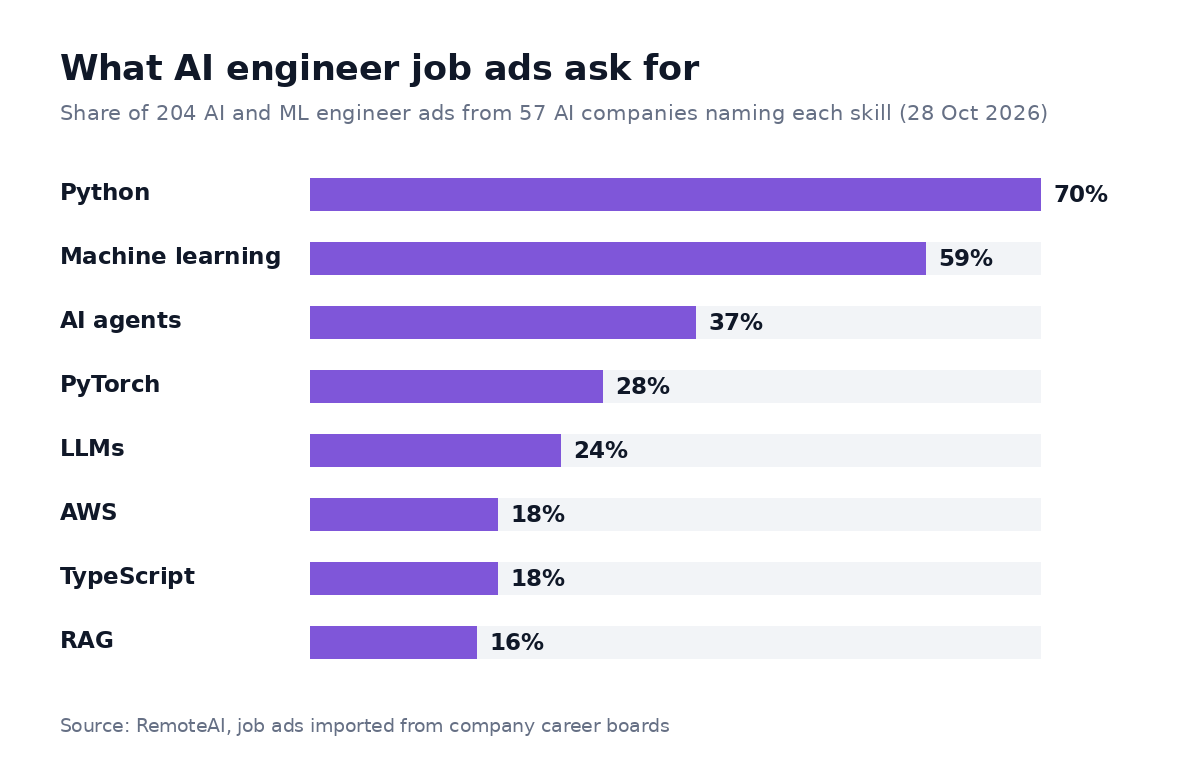
Skills named in the ad, as found by RemoteAI's skill tagging. One company, OpenAI, posted a quarter of the ads; without it, machine learning (76%) moves ahead of Python (64%) and PyTorch rises to 37%.
What this means for your ad:
- Python and one framework are the floor. You do not need to list five frameworks; name the one your team uses.
- "AI agents" and RAG are where you compete. If your product uses them, say so plainly, with an example of what the agent does. A concrete example tells a candidate more than the job title does.
- TypeScript shows up in about one ad in six. Those are teams where the AI engineer also builds the product around the model. If that is your job, put it in the requirements so the right people apply.
If you are not sure whether you need an AI engineer, an ML engineer or a data scientist, our guide on how to hire an AI engineer compares the three roles.
How much experience to ask for
Ask for the experience the work needs, not a round number. Of the 204 ads, 111 state a number of years. Five years is the most common figure, and very few ads open the door to beginners:
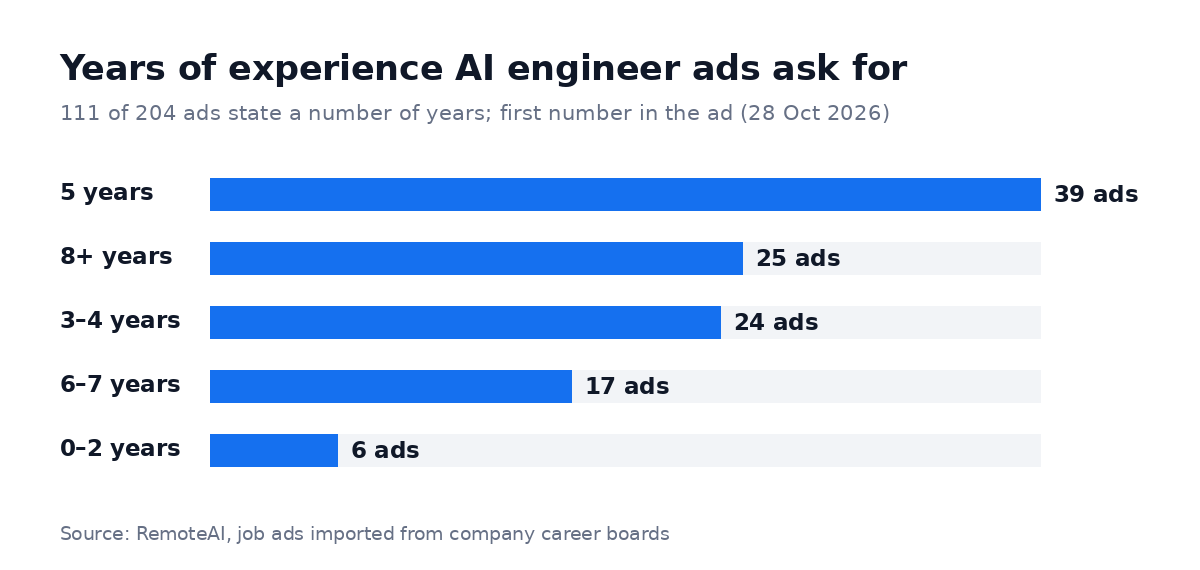
First number of years written in each ad. The other 93 ads give no number.
That gap helps you. When your project is well defined, for example adding retrieval to an existing product, an engineer with two or three years and one shipped AI feature can do it. Writing "3+ years, including one AI feature in production" is more useful than "5+ years of LLM experience", which few people can honestly claim for tools that are only a few years old.
Degrees: rarely the filter
Only 13 of the 204 ads mention a PhD, and 38 mention a bachelor's or a degree. Most of the requirements are about work done, not diplomas. If you ask for a degree, say whether it is required or a plus; "or equivalent experience" keeps strong self-taught engineers in your pipeline.
Research scientist roles are different: they often ask for a PhD and published work. Do not copy a research ad when you need someone to build product.
Write the pay range
Put the range in the ad. Several US states, including California, New York, Colorado and Washington, require it, and an ad without a range asks candidates to apply blind.
Among the 79 ads in our sample with a yearly range in US dollars, from 27 companies, the average posted range was $229,000 to $306,000. These are mostly well-funded AI companies, so treat it as the upper end of the market, not a typical figure. For a view by level, see our machine learning engineer salary guide. It compares posted ranges with BLS and Levels.fyi data.
In these ads, the top of the range is on average about 37% above the bottom (about $77,000). A much wider range tells candidates little about what you will really pay.
Variants: senior, applied and AI/ML engineer
The same template works for the common variants with a few changes:
- Senior AI engineer: add ownership: "lead the design of X", "mentor two engineers", "set our evaluation standards". Raise the range rather than the years.
- Applied AI or forward-deployed engineer: these roles work with customers to fit models to their data. Say how much time is customer-facing and how much travel there is.
- AI/ML engineer: if the person will train or fine-tune models, not only call them, add the training stack (PyTorch, GPUs, data pipelines) and say which models.
- Freelance or contract AI engineer: replace the salary with a day rate or a fixed price, and the responsibilities with deliverables and a deadline.
Five mistakes that cost you applicants
Avoid these when you edit the template:
- A wall of company boilerplate before the job. Put two lines about the company, then the work.
- Twenty requirements. Each extra "must have" can put off good people who match most of the list. Move the rest to "nice to have".
- Buzzwords without a task. "Passion for AI" says nothing; "build the agent that drafts replies to 2,000 tickets a day" says everything.
- No range. It costs you the candidates who will not apply blind.
- No hiring steps. Say how many interviews, whether there is a take-home exercise, and how long it takes.
Where to post it
Post it where AI engineers look. On RemoteAI, companies can post a job, and the first job each month is free. It stays open 14 days, and jobs from companies whose website is not verified are reviewed first. Paid plans for more jobs are on the pricing page. You can also browse machine learning engineer profiles or AI agent developers and contact people directly, and see which AI companies are hiring right now.
Method: 204 open roles imported by RemoteAI from the career boards of 57 AI companies on 28 October 2026, with "AI engineer", "ML engineer", "machine learning engineer", "LLM engineer", "applied AI", "GenAI engineer" or "forward deployed" in the title. Skills: RemoteAI's tagging of each ad. Experience: the first number of years written in the ad (111 ads). Degrees: ads mentioning "PhD" or a degree. Pay: the 79 ads with a yearly range in US dollars. OpenAI accounts for 52 of the 204 ads. The sample covers AI companies that publish their roles on public career boards, many of them large or well-funded; it is not a view of all companies hiring AI engineers.
Sources: RemoteAI job data: open roles imported from the public job boards the companies run on Greenhouse, Lever and Ashby, taken October 28, 2026. No outside survey is used.