An AI engineer at an AI-focused company is offered a median of about $247,750 a year in base pay, judging by the ranges these companies publish on their own job posts. The middle half of postings sit between about $203,000 and $293,000. Check the level first when you compare an offer: Staff and Principal titles are posted about a third higher than Senior ones.
What to know:
- On October 30, 2026 we read 1,889 open roles at 143 AI companies. 872 of them (46%) publish a pay range.
- Job posts with an AI engineer title had a median midpoint of $247,750 (68 postings with pay, 27 companies).
- Staff or Principal titles were posted at $284,925, Senior titles at $216,104; remote roles a little below the Bay Area.
- Python is asked for in 58% of technical postings; LLMs and AI agents in a third each.
Where these numbers come from
These numbers come from 872 job posts with a yearly US pay range, taken on October 30, 2026 from the public job boards (Greenhouse, Lever, Ashby) of 143 companies RemoteAI lists as AI employers, from model labs to data platforms such as Snowflake and Databricks. We read all 1,889 live postings, removed duplicates, and kept those with a range.
For each posting we used the midpoint of the range, then took the median across postings. For example, a posting for $200,000 to $260,000 counts as $230,000.
Read these figures as posted base pay at AI-focused companies: the ranges leave out equity and bonus, and they are offers, not salaries paid. The sample leans toward large, well-funded labs and AI product companies, so it sits above the wider market.
AI engineer pay: the headline number
Job posts with an AI engineer title (AI or ML engineer, applied AI engineer or architect, LLM or inference engineer) had a median midpoint of $247,750. OpenAI posted 20 of these 68; without architect, support and non-US roles the median is about the same ($249,750). The middle half of those postings ran from $203,125 to $292,500.
Across all 612 technical postings with pay (engineers, scientists and researchers at 62 companies), the median midpoint was $245,000. If you count each company once instead of each posting, the median falls to $225,000, because a few large labs post many roles at high ranges.
For AI engineer titles the typical range is wide: the top sits about 34% above the bottom, for example $211,000 to $278,000. The band is the room the company has published for itself.
Pay by level
Level moves posted pay more than location does:
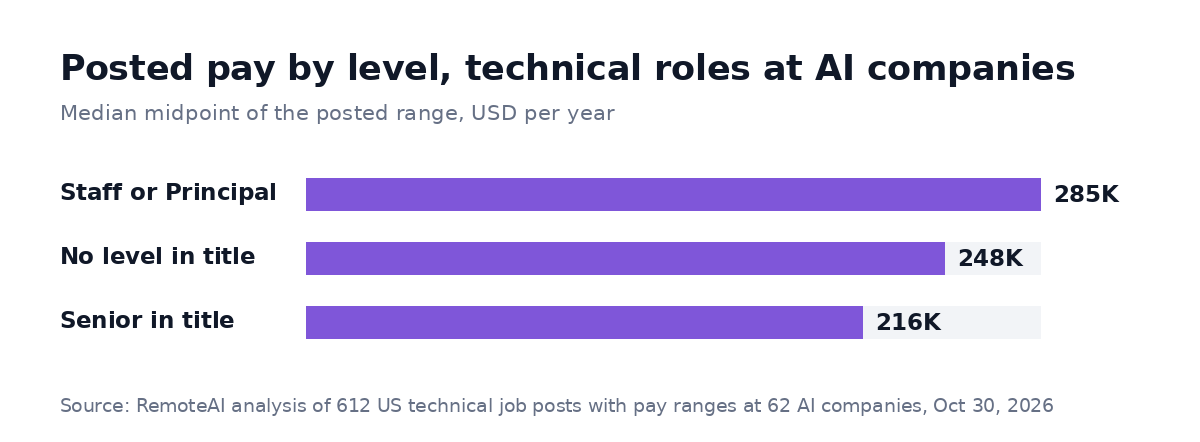
Median midpoint of posted pay ranges for technical roles at AI companies, by the level written in the job title. 138 Senior, 297 untitled and 171 Staff or Principal postings, October 30, 2026.
Many postings at these companies carry no level in the title at all, and their median sits between Senior and Staff.
Before your first technical round, ask which level the range covers. A role with no level, for example, can still be offered as Senior. And junior roles are almost absent: fewer than 2% of all 1,889 postings mention junior, intern, new grad or entry level.
Pay by location
Remote roles are posted a little below on-site ones, not far below. You save less than you might expect by hiring remotely:
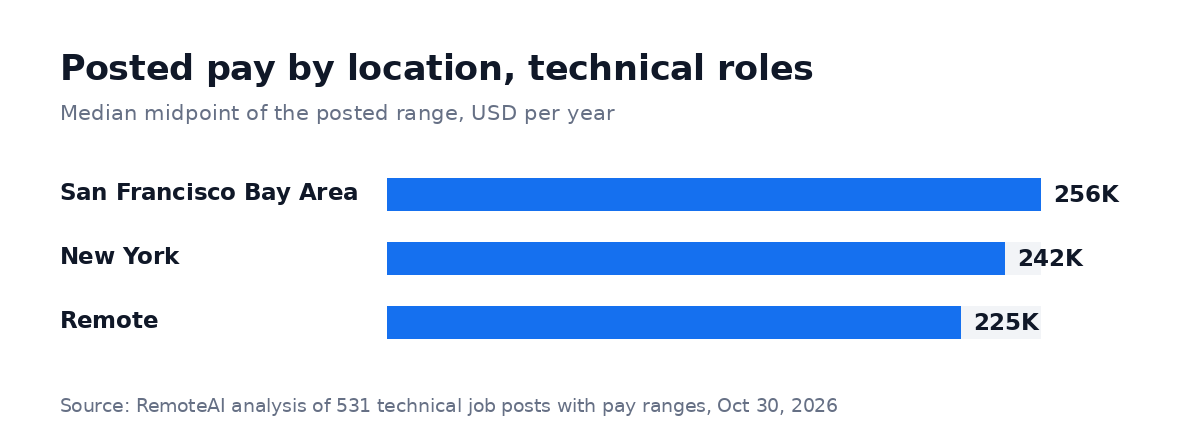
Median midpoint of posted pay ranges for technical roles: 298 postings in the San Francisco Bay Area, 37 in New York and 196 whose location says remote, October 30, 2026.
About 38% of all postings list a remote location, often limited to one country. Among AI engineer titles specifically, 26% are remote.
Who pays the most
Anthropic and OpenAI publish the highest ranges, followed by Lambda and Wayve. At the other end, Fireworks AI and Motional posted medians close to $200,000. Here are the companies with 20 or more technical postings that show pay:
| Company | Technical postings with pay | Median midpoint |
|---|---|---|
| Anthropic | 21 | $362,500 |
| OpenAI | 70 | $333,750 |
| Lambda | 26 | $330,500 |
| Wayve | 24 | $323,319 |
| Harvey | 41 | $285,000 |
| Baseten | 42 | $247,500 |
| Snowflake | 52 | $243,750 |
| Databricks | 31 | $213,750 |
| Fireworks AI | 22 | $201,250 |
| Motional | 21 | $200,500 |
Equity changes the picture. Posted ranges leave out stock, so they understate total pay wherever equity grants are large.
You compete with that stock when you hire from a lab. A Staff engineer leaving one, for example, will ask how your offer compares.
Forward deployed engineers
Forward deployed engineers are posted at a median midpoint of $232,500, close to AI engineers (27 postings with pay). The role, building AI systems on site with customers, is not rare: we counted 87 such postings (about 5% of all roles) at 29 companies. Our guide to the forward deployed engineer role explains what the job involves.
What these companies ask for
These companies ask for Python first, then cloud infrastructure, LLMs and AI agents. To measure it, we read the text of 1,496 technical postings. We removed the paragraphs a company repeats in all its ads (often a mission statement that mentions agents), so the figures count what the role itself asks for:
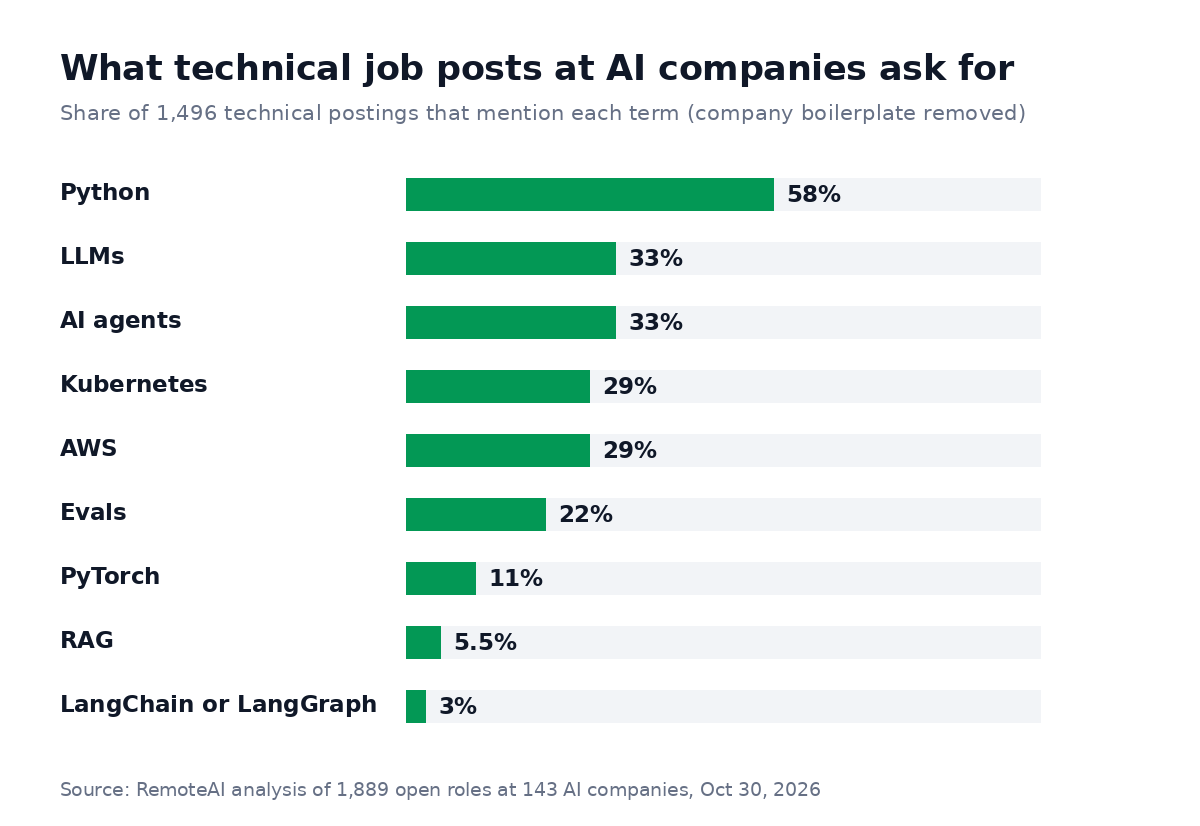
Share of 1,496 technical postings at the companies in our snapshot that mention each term after company boilerplate is removed, October 30, 2026.
Python leads by a wide margin. Infrastructure comes next: Kubernetes and a cloud platform appear in almost a third of postings. LLMs and AI agents each appear in a third of postings, evaluation or benchmarks in about a fifth (evals named as such: 13%).
Framework names are rare. LangChain or LangGraph appear in 3% of postings, RAG in 5.5%. Postings describe the system to build far more often than the library to build it with. These companies hire for the problem (shipping a reliable agent, measuring a model) more than for a library.
What this means if you are hiring
If you hire a full-time AI engineer in the US and compete for the same people as these companies, use these ranges as your benchmark. A few practical points:
- Post a range. Almost half of the AI companies in our sample already do, and candidates compare.
- Name the level. A Staff role and a Senior role differ by about a third in posted pay. Saying which one you mean saves a round of interviews.
- Ask for the work, not the framework. Describe the system to build and how you will measure it.
- Consider a project first. For a defined piece of work, such as an agent, an evaluation suite or a retrieval system, a contractor can deliver it without a full-time salary.
On RemoteAI you can browse AI and machine learning engineers and AI agent developers, message a profile directly, or post a job. For salaries in a neighbouring role, see our machine learning engineer salary guide.
What this means if you are looking for work
You can use the same numbers on the other side of the table. Ask for the posted range at your level, and check which level you are being hired at before you discuss pay. Show the skills these postings actually name, such as evaluating a model or running an agent in production, rather than a list of libraries. You can browse open AI jobs on RemoteAI.
Next steps
Your next step is to decide the level of the role before you set its pay, then compare your range with the medians above for that level and location. If the work is a defined project rather than a permanent seat, write a short brief and get quotes from specialists before opening a full-time role.
Method: RemoteAI snapshot of 1,889 unique open roles at 143 companies RemoteAI lists as AI employers (model labs, AI product companies and data platforms), taken from their public applicant-tracking job boards on October 30, 2026 (postings first listed between August 4 and October 30, 2026). Pay figures use the 872 postings with a yearly range in US dollars (minimum $40,000) for US or remote locations; postings located only outside the US are excluded. "Midpoint" is the middle of the posted range; medians are across postings unless stated, so companies with many postings, such as OpenAI, weigh more. Ranges are posted base pay, not salaries paid, and exclude equity and bonus. The sample leans toward large, well-funded companies and sits above the wider market. Levels come from job titles; "remote" means the location text says remote. Skill shares count postings whose text mentions a term after sentences repeated in 40% or more of a company's postings are removed; "evals" includes mentions of benchmarks.