Ask ten people what a data scientist earns and you will hear numbers from $70,000 to well over $300,000. None of them is wrong: pay depends on the industry, the level, the type of company — and on whether you count stock and bonuses.
This guide gives the salary of a data scientist from the two most cited sources, shows how it changes by industry and level, and explains which skills move it up — with data from the 1,287 reviewed data science professionals on RemoteAI.
The salary of a data scientist at a glance
- Official US median: $120,230 a year. That is the U.S. Bureau of Labor Statistics figure for data scientists (May 2025). The lowest-paid 10 percent earned under $67,240; the highest-paid 10 percent, over $199,130.
- Tech-company total pay: $180,000 median. Levels.fyi collects self-reported packages — salary, stock and bonus — mostly from technology companies. Its 25th percentile is $135,000 and its 90th, $340,000.
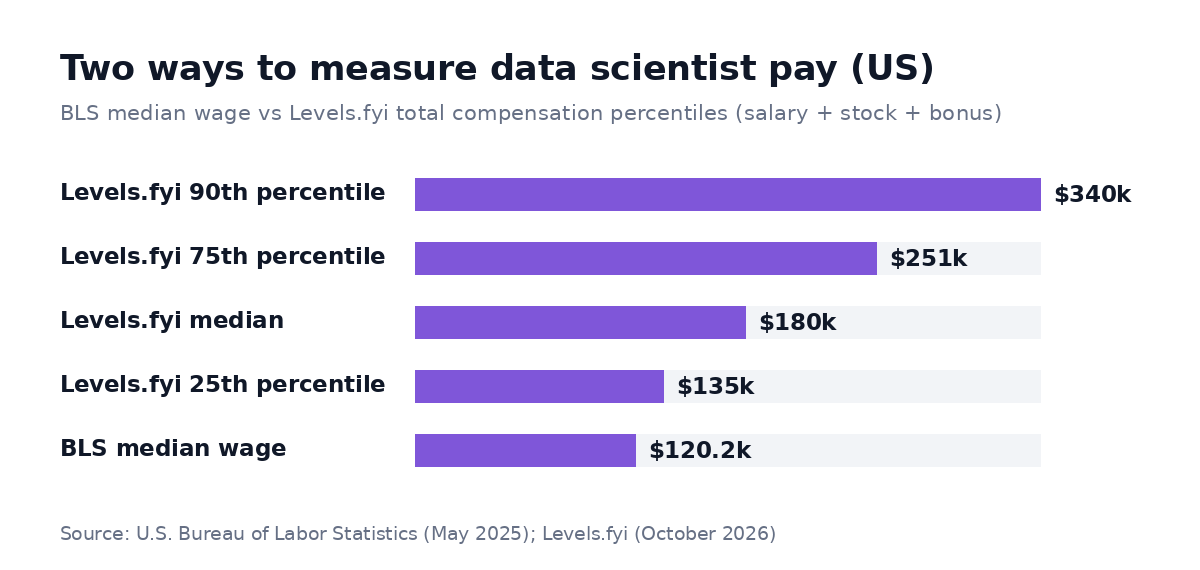
The BLS counts wages across all employers; Levels.fyi adds stock and bonuses and leans toward tech companies.
Which number should you use? The BLS figure if you work — or hire — outside big tech. Levels.fyi if you are comparing offers from technology companies, where stock can be a large part of the package.
Pay by industry
The same job title pays differently depending on who employs you. Among the industries that employ the most data scientists, the BLS reports these median wages:
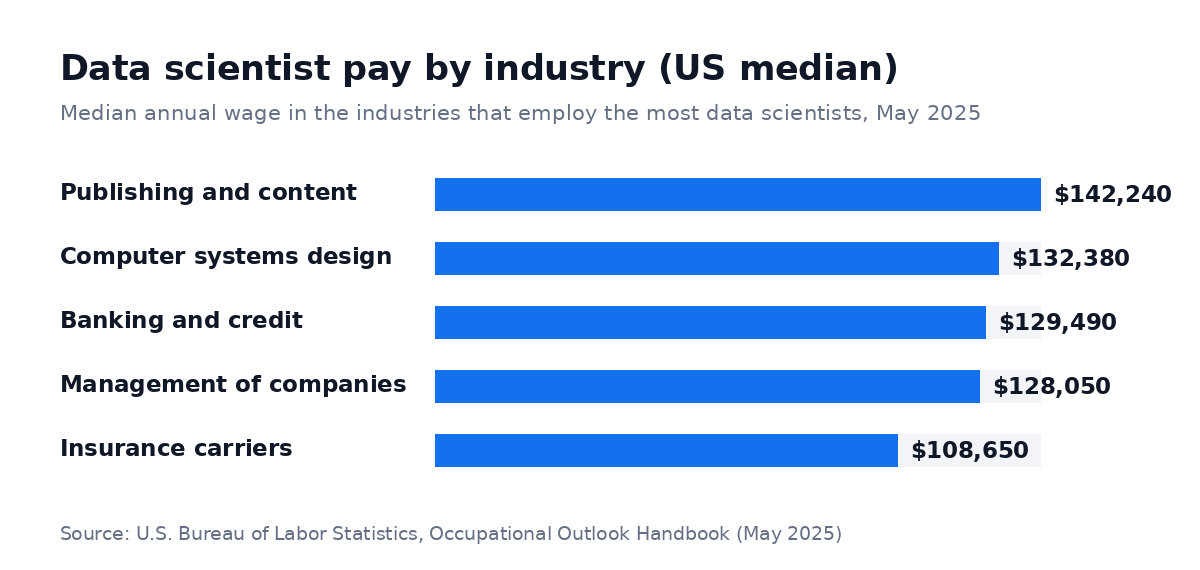
U.S. Bureau of Labor Statistics, Occupational Outlook Handbook — median annual wages, May 2025.
Two lessons stand out. First, the gap between industries — more than $33,000 between the top and the bottom of this list — is as large as the gap between some career levels. Second, finance and insurance employ many data scientists for risk, pricing and fraud models; that domain knowledge is valued and travels well between employers in the same sector.
Pay by level
Seniority changes pay more than any other factor, and the job changes with it:
- Entry-level and junior: cleaning data, building reports and first models under supervision. Pay sits below the median; the fastest way up is owning one analysis or model end to end.
- Mid-level: independent projects, choosing methods, presenting results to business teams. Around the median and above in high-paying sectors.
- Senior: owning a domain — pricing, churn, recommendations — and the models behind it in production. Clearly above the median.
- Lead and principal: setting methods and standards for a team, mentoring, deciding what to build. At tech companies, these levels make up much of the top 10 percent.
The market is crowded at the start and thin at the top. Among reviewed data science profiles on RemoteAI, about 43% are entry-level or junior, 35% mid-level and 20% senior. If you have senior experience, you are in the smaller group — use it when you negotiate.
The skills behind higher pay
Python and SQL are the basics of the job, and most data scientists list them. What separates profiles is everything that turns an analysis into a system people use:
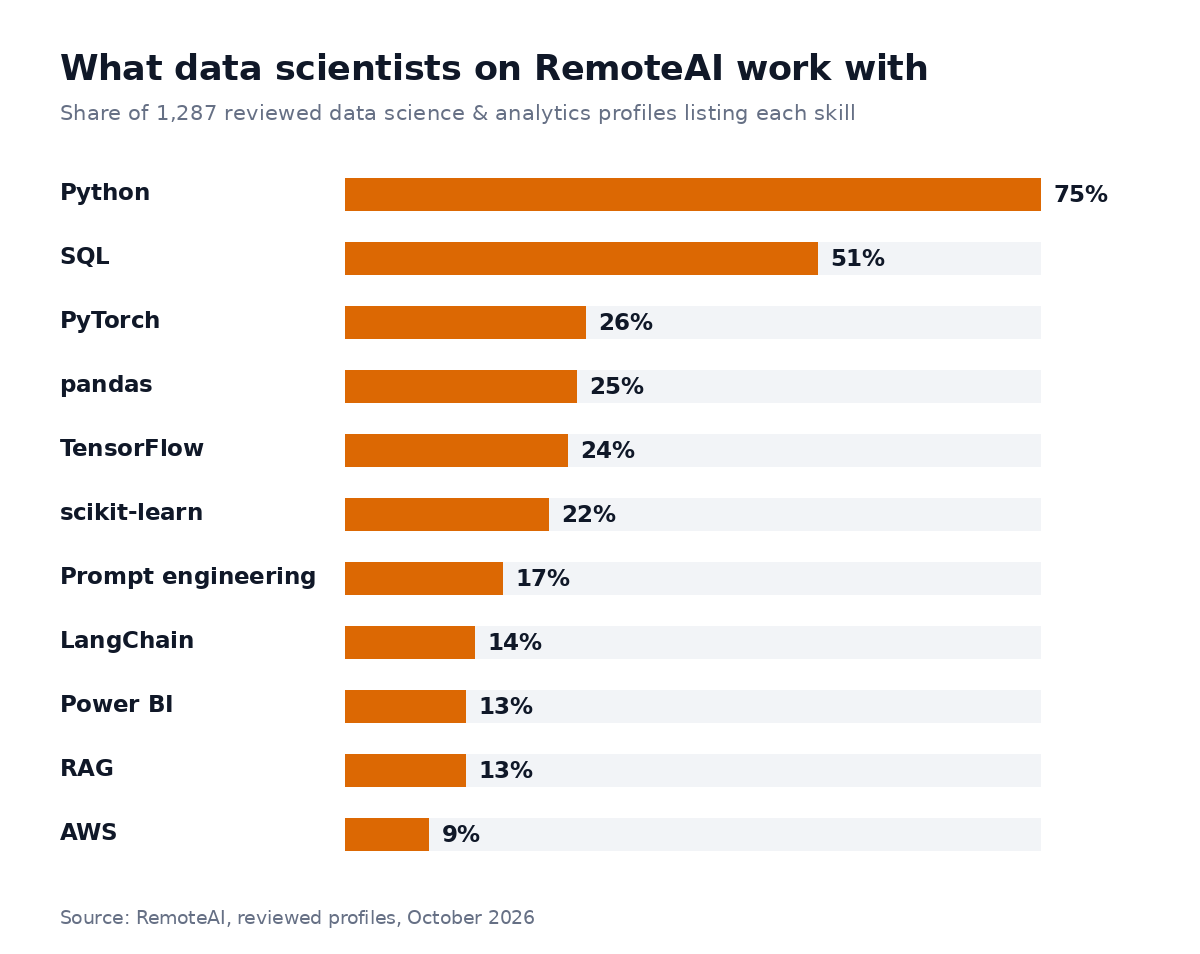
Only 9% list AWS and 13% list RAG — production and LLM skills are where the market is thin.
The skills worth adding to raise your pay:
- Machine learning in production: packaging a model, serving it, monitoring it. Data scientists who can ship are paid closer to ML engineers.
- Cloud data platforms: AWS, GCP or Azure, plus a warehouse such as Snowflake or BigQuery. Most company data now lives there.
- Large language models: retrieval (RAG), evaluation and prompt design applied to business data — a fast-growing part of data science work.
- Experimentation: A/B testing done properly — sample sizes, guardrail metrics, honest reporting. Product companies pay for people who can say what really worked.
- Communication: turning results into a decision. It is the skill that most often separates senior from mid-level pay.
Our study of the AI skills in demand compares what job posts ask for with what professionals offer — several of the scarce skills, such as Spark, Snowflake and MLOps, are part of the data scientist toolkit.
Location and remote work
Pay is highest in the biggest US tech and finance hubs, and many employers adjust salaries to where you live. Remote roles change the math: you can work for a company in a high-paying market from elsewhere, though some employers apply location bands even for remote work. When you compare offers, ask how the salary band is set — by role, by country or by city.
Data scientist or machine learning engineer?
The two roles overlap, and pay follows the work rather than the title. A data scientist who mostly analyzes data and builds models for decisions is paid like a data scientist. One who also deploys and maintains those models in production is paid closer to a machine learning engineer. See our guide to the machine learning engineer salary for that side of the market.
How to negotiate a data scientist offer
Most offers have more room than they show. A few habits make the difference:
- Know which number you are discussing. Ask for the full package in writing: base salary, bonus target, stock or equity and its vesting schedule, and the sign-on bonus. Compare packages on the same basis — yearly value, not headline totals.
- Bring proof of impact. "Built a churn model that cut cancellations by 8%" or "replaced a weekly manual report with an automated pipeline" is worth more than any list of tools. Hiring managers pay for results they can picture.
- Use the industry gap. If you move from a lower-paying sector to a higher-paying one, the BLS medians above are a fair, neutral reference to bring to the table.
- Negotiate what moves. When base salary is capped by a band, the level, the title, the sign-on bonus, remote days and a training budget often are not.
- Have a second process running. Nothing changes an offer faster than a real alternative.
- Ask about the review cycle. When is the next salary review, and what does a raise depend on? A clear answer now avoids waiting two years for the next jump.
Freelance and contract data science
Many data scientists work as freelancers or contractors, at least part of the time. The work comes as defined projects: a forecasting model, a customer segmentation, an A/B test analysis, a cleaned dataset with a dashboard on top.
Freelance pay depends less on titles and more on how clearly you scope the work. Professionals who earn well tend to sell outcomes with a fixed price per milestone — "a weekly sales forecast with an error report" — rather than open-ended hours. They also keep a short portfolio of past projects with the business result of each, which replaces the CV in most freelance decisions.
On RemoteAI, companies post data projects and invite matching profiles directly, and experienced data scientists can show fixed-price services on their profile, so companies see the scope and price up front.
The outlook
Demand keeps growing. The BLS counts 275,600 data scientist jobs in 2025 and projects 35% growth from 2025 to 2035, much faster than the average for all occupations. The growth is strongest where data science meets production systems and AI products.
Looking for your next role? Browse data scientist jobs and all remote AI jobs, or create your free profile so companies hiring data scientists can find you.
Sources: U.S. Bureau of Labor Statistics — Data Scientists (May 2025 wages, 2025–2035 projections); Levels.fyi — Data Scientist compensation (October 2026). RemoteAI figures: reviewed data science & analytics profiles, October 2026.