You send a resume, nothing happens, and you wonder whether a machine threw it away. An AI resume checker promises to tell you why, in seconds, with a score.
Some of what these tools find is genuinely useful. Some of it is noise. This guide explains what an AI resume checker really checks, how applicant tracking systems read your resume, the free options, the mistakes no checker will catch for you, and a 15-minute routine to use before every application.
What an AI resume checker actually checks
Most tools run the same few checks, with different names:
- Keywords. They compare your resume with a job description and list the skills and terms that are missing.
- Parsing. They test whether software can read your resume: sections, dates, job titles, contact details.
- Bullet points. They flag weak verbs, missing numbers and sentences that describe duties instead of results.
- Length and structure. Too long, too dense, missing sections, inconsistent dates.
- Language. Spelling, grammar, repeated words.
That is useful. But notice what is missing from the list: whether your experience is relevant, whether your projects are impressive, whether a recruiter would believe you. A checker reads text. It does not know your field.
How applicant tracking systems read your resume
An applicant tracking system (ATS) is the software companies use to receive and organize applications. It turns your file into fields — name, titles, dates, skills — and lets recruiters search and filter. Two things follow from that:
- If the system cannot parse your resume, you are invisible. Text inside images, two-column layouts built with tables, and important details in headers or footers often come out scrambled.
- Recruiters search for skills. If the job asks for "PyTorch" and your resume says "deep learning frameworks", a search may not find you.
A simple layout and the exact names of the tools you use solve most of this. You do not need tricks, hidden keywords or white text; those get noticed and hurt you.
The free options
You do not need to pay to get value from an AI resume checker:
- Free tiers of resume tools. Most popular resume builders offer a limited free scan with keyword and format checks.
- A general AI assistant. Paste the job description and your resume, then ask precise questions: "Which required skills from this job are missing from my resume?", "Which bullet points describe duties instead of results?", "What would a hiring manager for this role doubt?"
- A second pair of eyes. A friend in your field still catches things no tool will.
Before pasting a resume into any tool, remove your phone number, home address and anything you would not post publicly.
What no AI resume checker will tell you
The most common problems we see on AI profiles are not about keywords. They are about proof:
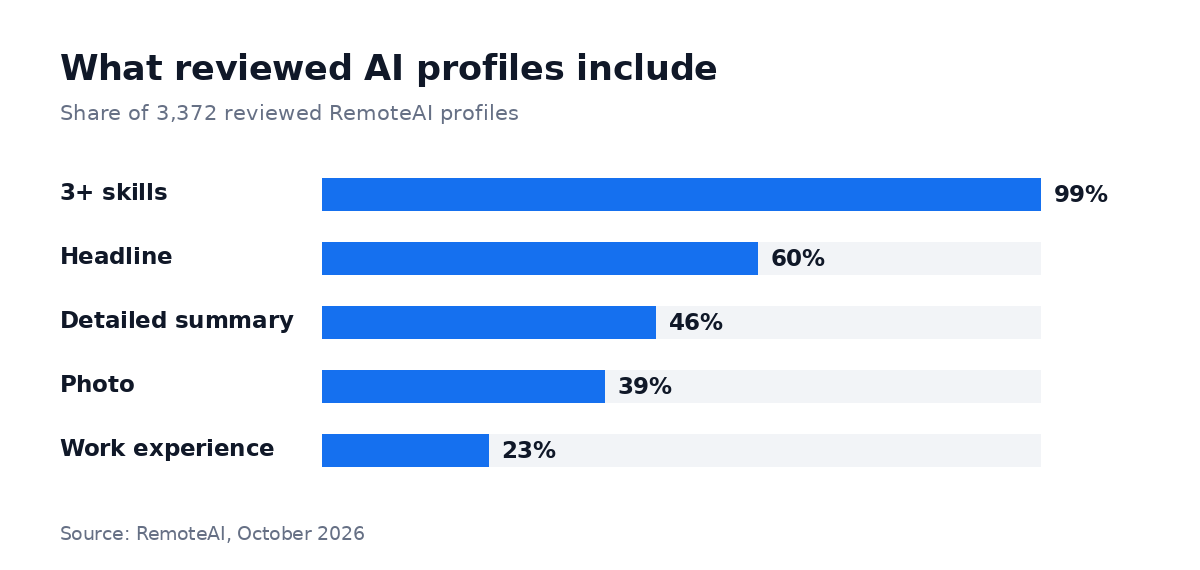
Share of 3,372 reviewed RemoteAI profiles that include each element, October 2026.
Almost everyone lists skills. Far fewer explain what they did with them. A checker will happily score a resume full of the right keywords and no evidence. Recruiters do the opposite: they skim the skills, then look for the project that proves them.
What to check yourself:
- Is your best work on the first half of page one? If your strongest project is at the bottom, most readers never reach it.
- Does each role say what changed? "Built a RAG assistant that answered 60% of support questions without an agent" beats "Worked on LLM applications".
- Can you explain every line in an interview? If an AI tool wrote a sentence you cannot defend, delete it.
- Is it written for this job? A resume tuned for a data analyst role reads oddly for an ML engineer role.
Mistakes these tools often make
- Stuffing keywords. Adding every missing term makes a resume longer and less believable.
- Generic rewrites. "Results-driven professional with a passion for innovation" says nothing. Recruiters now see the same AI phrases all day.
- Chasing the score. A score is the tool's own formula, not a prediction that someone will reply.
- Inventing numbers. If you do not know the exact impact, describe the result honestly instead of making up a percentage.
How recruiters actually respond
On real job posts on RemoteAI over the last six months, about one application in ten was shortlisted by the company, and most of the rest were never answered either way. A cleaner resume improves your odds, but so do the applications you choose: roles that match your strongest skills, posts with a clear description, and companies that are actively hiring.
That is also why applying through your profile matters as much as the file you upload. A complete profile with a clear headline, a detailed summary of what you built and your work experience gives a company the same proof a good resume does, before it opens any attachment.
Before and after: three bullet points rewritten
The fastest gains usually come from turning duties into results. Three examples from AI roles:
| Before | After |
|---|---|
| Worked on machine learning models for the sales team. | Built a churn model in Python that flagged at-risk accounts two weeks earlier; the sales team now calls them first. |
| Responsible for prompt engineering. | Rewrote the support assistant's prompts and added an evaluation set of 200 real questions; wrong answers fell by a third. |
| Used n8n and APIs to automate processes. | Automated invoice intake with n8n and an LLM step, removing about 6 hours of manual entry a week. |
Each "after" names the tool, the action and what changed. An AI assistant can help you find this shape, but only you know the real result. If you do not have a number, describe the outcome in words rather than inventing one.
Resume checker, ATS checker or human review?
| You want to know… | Best tool |
|---|---|
| Whether software can read my resume | An ATS or parsing check |
| Which skills from this job I am missing | An AI resume checker or assistant, with the job description |
| Whether my experience is convincing | A person who hires in your field |
| Whether my profile stands out on a platform | Your own profile, compared with others in the same role |
Use the cheap, fast checks first, then spend a person's time on the question only a person can answer.
A 15-minute routine before each application
- Read the job post twice and underline the five skills or results it asks for most.
- Run a checker or ask an AI assistant which of those five are missing or weak in your resume.
- Fix the top half of page one: headline, summary and your most relevant project, written for this job.
- Turn two duty bullets into result bullets with real numbers where you have them.
- Check the layout parses: a single column, standard section names, no text in images.
- Read it out loud once. Anything that sounds like a template, rewrite in your own words.
Where to apply next
A strong resume matters most when it reaches the right role. Browse remote AI jobs, or start from a role that matches your skills: AI engineer jobs, prompt engineer jobs or data scientist jobs.
If you are still choosing a direction, our guide to the AI skills in demand shows what companies ask for most, and the machine learning engineer salary guide helps you set expectations. When you are ready, create your free RemoteAI profile and apply with it.
Sources: RemoteAI reviewed talent profiles and application outcomes on real company job posts (last six months), October 2026.