An AI knowledge base lets people ask a question and get an answer drawn from your own company documents, with links to the sources, instead of searching folders. The tools in this guide work the same way: they find the most relevant passages and give them to an AI model with the question. The tool matters less than the content. Old, duplicated or over-shared documents produce wrong or risky answers.
What to know before you start:
- It answers from your documents. The quality of the answers follows the quality of the content.
- It can still be wrong. Retrieval reduces errors; it does not remove them.
- Permissions carry over. The AI shows what users can already access, including what is shared too widely.
- You may already pay for one. Several workspace tools include AI answers in their plans.
How an AI knowledge base works
AI knowledge bases are commonly built on retrieval-augmented generation, or RAG. AWS explains the steps: "The user query is converted to a vector representation and matched with the vector databases," and the system then "augments the user input (or prompts) by adding the relevant retrieved data in context." The benefit, in AWS's words: "RAG allows the LLM to present accurate information with source attribution."
Anthropic describes RAG as "a method that retrieves relevant information from a knowledge base and appends it to the user's prompt." How well it works depends on retrieval: in Anthropic's own benchmark, adding context to each chunk for both embedding and keyword search "can reduce the number of failed retrievals by 49% and, when combined with reranking, by 67%."
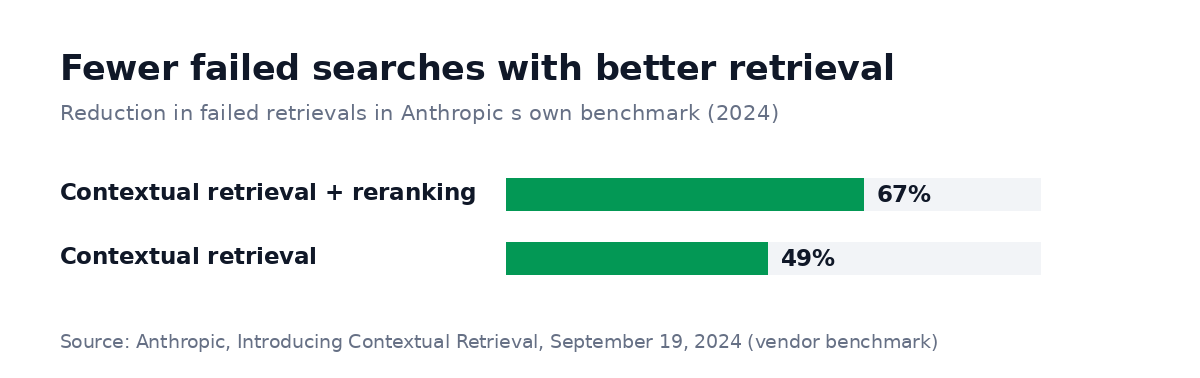
Figure: reduction in failed retrievals in Anthropic's benchmark, from its "Introducing Contextual Retrieval" post of September 19, 2024. These are the vendor's own results.
In plain terms, the AI can only answer well if it finds the right passage first. That's why document structure, titles and clean content matter as much as the model.
Why companies want one
The case is time. Atlassian's State of Teams 2025 survey of 12,000 knowledge workers and 200 executives reports that leaders and teams "waste 25% of their time just searching for answers." Atlassian sells Confluence and Rovo, so read that as vendor research, but most teams recognize the problem: the answer exists somewhere, and nobody can find it.
What the tools cost
Here is what pricing pages showed on November 11, 2026:
- Slite: Basic at $10 and Pro at $20 per user a month, billed yearly. Basic includes "Ask (AI search & answers)" with "30 monthly questions per seat"; Pro adds the Slite Agent and search across connected tools.
- Confluence with Rovo: Atlassian says "no separate Rovo purchase is required" on Standard, Premium and Enterprise Cloud plans. Rovo includes 25, 70 or 150 credits per user a month by plan, pooled, then "$0.01 per credit." From December 3, 2026, Atlassian bills use beyond that pool, and extra usage is on by default; an admin can set a spending cap or turn it off. Confluence seat prices did not load for us that day, so check them on Atlassian's page.
- Notion: Notion says "Notion AI is available on Business and Enterprise Plans," while Free and Plus users get a limited number of free AI responses to try it. Business includes Notion Agent, AI meeting notes and enterprise search. Notion's pricing page listed Business at $20 per member a month on November 13, 2026; check there whether that price is for yearly or monthly billing.
- Guru: no public prices; Guru sells "tailored" packages through a call.
For a customer-facing knowledge base, some help-desk AI agents are priced per outcome. Intercom's Fin costs "from $0.99 per Fin outcome", with a monthly minimum when Fin runs on another help desk.
Why answers can still be wrong
RAG makes answers better, not perfect. A Stanford study of AI legal research tools that use retrieval found that, while "hallucinations are reduced relative to general-purpose chatbots," the tools "each hallucinate between 17% and 33% of the time." Those were legal tools, so the rate will differ for your content, but the lesson holds.
Three habits reduce the risk:
- Show the source with every answer, so people can check it in one click.
- Remove old and duplicate documents before you turn the AI on. Two versions of the same policy produce two answers.
- Review answers on high-stakes topics, such as pricing, legal terms or safety, before people act on them.
Permissions: the risk that is easy to miss
Good tools respect your existing access rules. Notion says its AI "still follows your workspace access rules and only uses information it has permission to see." Atlassian says restricted third-party data "can only be seen and used in Rovo by those users who already have access to that content."
That is reassuring, and it is also the risk. If a salary sheet or a client contract is shared with the whole company today, the AI will find it and quote it. Before launch, review who can see what, starting with HR, finance and client folders.
A worked example: a 50-person company
Here's a first-year budget for 50 people on Slite Pro, billed yearly, at the price on Slite's page:
- Seats: 50 × $20 × 12 = $12,000 a year.
- Content cleanup (assumption): about 40 hours of one person's time to archive old pages, merge duplicates and fix permissions.
- Review (assumption): about 2 hours a week to check flagged answers and update pages.
If you already pay for Confluence on a Standard plan or higher, Rovo's AI answers come with it, and the main costs are the cleanup time and any credits used beyond the included pool, at $0.01 each. At an assumed $50 an hour for internal time, cleanup is about $2,000 and review about $5,200 (2 hours × 52 weeks), so the first year comes to about $19,200, or about $13,200 on Slite Basic if 30 questions per seat a month is enough. The hours and the rate are our assumptions; your content volume decides them.
How to set one up
Here's a simple order for a company of 20 to 1,000 people:
- Pick the home for your knowledge. If you already use Confluence or Notion, start there.
- Clean the content. Archive what is out of date, merge duplicates and give each page a clear title and owner.
- Fix permissions on sensitive folders before the AI is switched on.
- Start with one team, such as support or HR, and the 50 questions they get most.
- Measure how often the AI answers with a correct source, and fix the pages behind the wrong answers.
- Extend to other teams once the first one trusts it.
If you want the same knowledge to answer customers on your website, see our guide to an AI chatbot for your website.
When to bring in a specialist
Bring in a specialist when your knowledge lives in several systems, when you need answers inside your own product, or when off-the-shelf retrieval gives poor results on your documents.
The closest packaged work in RemoteAI's service templates (October 2026) is a chatbot that answers from your documents and cites its sources. RemoteAI suggests specialists start at $250 for one on up to 50 pages with a website widget. A larger package covers up to 300 pages or files, a hand-over to a person and an answer quality report; ask for a fixed quote. An internal assistant in Slack or your intranet, connected to several systems, is not one of those packages, so ask for a fixed price with the deliverables in writing.
You can compare RAG engineers and chatbot developers on RemoteAI, or post your project with where your documents live and how many people will ask questions.
Next steps
Your next step is to list where your company's knowledge lives today and who can see it. Clean one team's content, turn on the AI in the tool you already use, and test it on that team's most common questions for a month before you roll it out.
Sources: AWS, What is RAG?; Anthropic, Introducing Contextual Retrieval, September 19, 2024; Atlassian, State of Teams 2025; Magesh et al., Hallucination-Free? Assessing the Reliability of Leading AI Legal Research Tools, Stanford, 2024; Notion AI FAQ; Atlassian, connector permissions; pricing pages of Slite, Atlassian Rovo, Notion, Guru and Intercom; all read November 11, 2026. RemoteAI service templates (suggested starting prices), October 2026.