Missed calls are lost customers. Think of a clinic that cannot answer during busy hours, or a real estate agency that calls leads back the next day. Each of them loses people who simply call someone else.
An AI voice agent answers those calls, holds a natural conversation and acts on it. For example, it books the appointment, answers the question, qualifies the lead or passes the call to the right person. This guide explains how it works, what it really costs per minute, where it pays off and what to check before you put one in front of your customers.
What is an AI voice agent?
An AI voice agent is software that talks on the phone (or in a browser or app) like a person. Unlike the old "press 1 for sales" menus, it understands free speech and replies in its own words.
Under the hood, every call runs through the same loop, many times a second:
- Speech-to-text turns what the caller says into text.
- A language model (LLM) decides what to answer and which action to take, following your instructions and your business information.
- Text-to-speech turns the answer into a natural voice.
- Telephony connects all of this to a real phone number.
During the call, the agent can also use tools. It can check your calendar, create a booking, look up an order, write a summary to your CRM or transfer the call.
What an AI voice agent costs
Voice agents are priced by the minute of conversation, and each part of the loop above has its own price. Here is one minute on Retell AI's default pay-as-you-go setup:
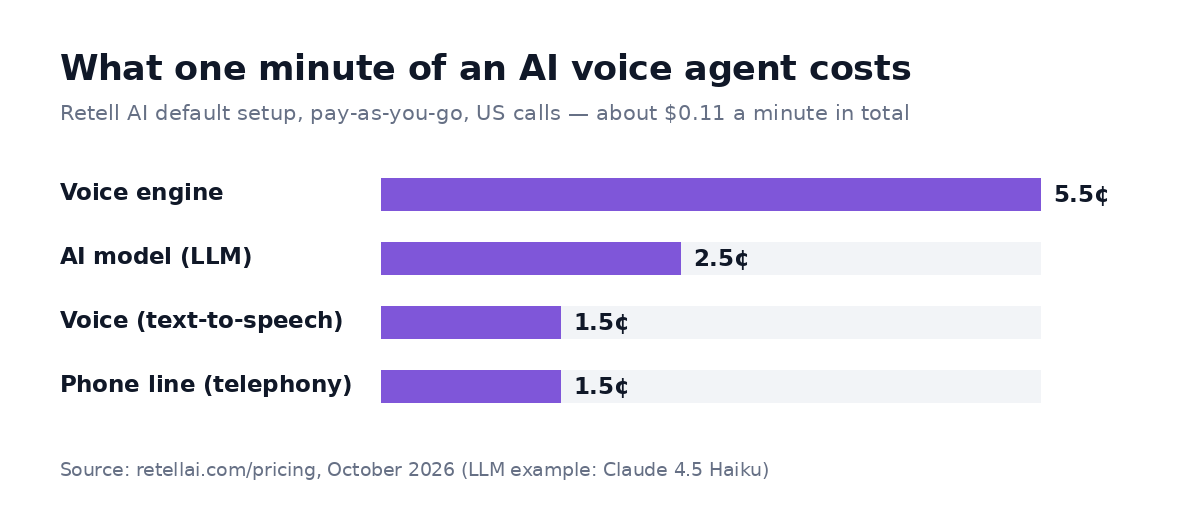
Retell AI pricing page, October 2026 — the language model shown is Claude 4.5 Haiku; larger models cost more per minute.
The main pricing models you will meet:
- Retell AI: pay-as-you-go from about $0.07 to $0.31 a minute depending on the voice and model, with about $0.11 a minute for the default setup, $10 of free credit and 20 concurrent calls included.
- Vapi: a $0.05 per-minute platform fee, with speech-to-text, the language model, the voice and the phone line billed at the providers' cost on top. Vapi's own telephony and web calls are free; Twilio numbers cost about $0.008 a minute inbound and $0.014 outbound.
- Synthflow: enterprise contracts, starting at $30,000 a year according to its pricing page.
Put in monthly terms, the difference with staffing a phone line is large — though the two are not doing exactly the same job:
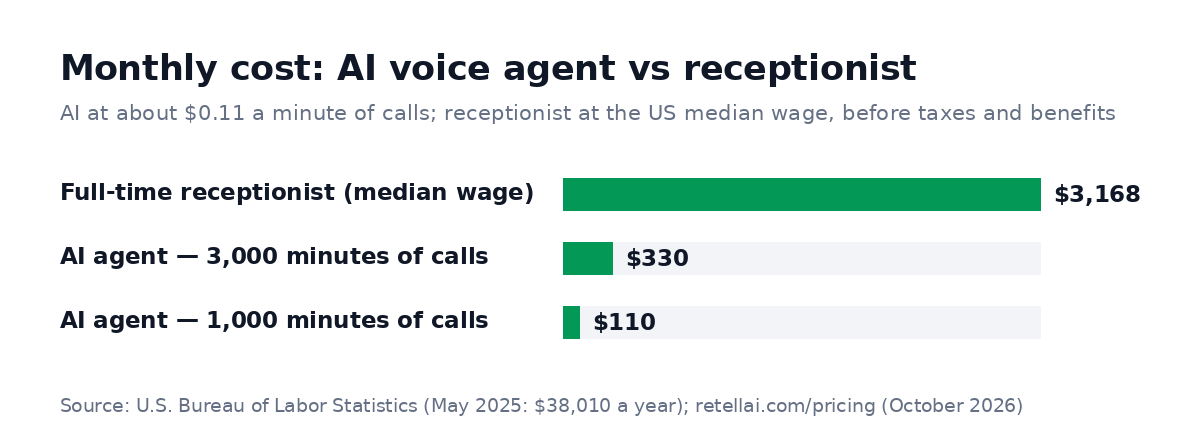
Receptionist: U.S. Bureau of Labor Statistics median of $38,010 a year (May 2025), before taxes and benefits. AI: about $0.11 a minute of calls.
The usage cost is rarely the expensive part. The real budget goes into building and tuning the agent: writing its instructions, connecting it to your tools, and testing it on real calls until it handles the awkward ones.
Where AI voice agents pay off
AI voice agents pay off where calls are many, requests are predictable and each call ends with a clear action. Here's where that's usually true:
- Customer service: answer the questions that make up most calls — opening hours, order status, prices, returns — and pass the rest to a person with a summary.
- Appointment booking: clinics, salons, repair services and consultants book, move and confirm appointments directly in the calendar, day and night.
- Lead qualification and follow-up: call new leads within minutes, ask the qualifying questions and book a meeting for the sales team. Speed matters: a lead called back the same minute is far more likely to answer than one called the next day.
- Healthcare intake: collect the reason for the visit, insurance details and availability before a human takes over — with strict rules on what the agent may say.
- Real estate: answer listing questions, qualify buyers and book viewings outside office hours.
- After-hours answering: for small businesses, the simplest win is answering every call when nobody is available, instead of sending it to voicemail.
For a small business focused on the phone line, our guide to the AI receptionist for small business goes step by step.
Where they struggle
Voice agents struggle in a few places, so plan for these weak spots:
- Unusual requests. Anything outside the agent's instructions should be transferred, not improvised.
- Noisy lines and strong accents still cause misunderstandings. Test with your real callers, not only in a quiet office.
- Latency. A pause of more than a second feels unnatural. The choice of model and voice affects speed as much as cost.
- Making things up. Limit the agent to your own information (prices, policies, opening hours) and tell it to say when it does not know.
- Bad hand-offs. A transfer that drops the caller into a queue with no context undoes the good start. Pass a short summary with every transfer, and send a text or email when nobody can pick up.
Rules and trust
Callers trust an AI agent when you follow a few rules:
- Say it is an AI. Announce at the start of the call that an AI assistant is answering. People accept it far better than discovering it later. For example: "Hi, you've reached the clinic. I'm the clinic's AI assistant. I can book or move an appointment, or put you through to the team."
- Outbound calls need consent. In the US, the FCC ruled in 2024 that AI-generated voices count as "artificial" voices under the TCPA, so automated calls with them generally require the person's prior consent. Other countries have their own rules — check before you call anyone.
- Recording and data. Calls are often recorded and transcribed; tell callers, and keep personal and health data out of the model's memory unless your setup is built for it.
Build it yourself or hire a specialist?
Do it yourself if you only need the agent to answer common questions and take messages. Platforms like Retell or Vapi have templates you can configure in an afternoon.
Hire a specialist if the agent must book in your calendar, update a CRM, transfer calls by urgency or run outbound follow-ups. Those integrations, plus testing on real calls, decide whether callers have a good experience. As a guide, these are the starting points RemoteAI suggests to specialists for fixed-price voice projects:
| Scope | Typical content | Suggested starting price |
|---|---|---|
| Essential | Answers common questions, takes messages, call summaries | from about $300 |
| Standard | Books appointments in your calendar, transfers urgent calls | from about $700 |
| Premium | Booking, reminders and follow-ups, CRM update after each call, 2 weeks of tuning | from about $1,400 |
Specialists set their own prices; usage (the per-minute cost above) is paid directly to the platform.
When you hire, ask to call an agent they built. Two minutes on the phone tell you more than any portfolio: how fast it answers, how it handles an interruption, and what happens when you ask something it should not answer.
How to get started
To get started, take these steps in order:
- List your calls. Take a week of calls and sort them by reason. The top three reasons are your first scope.
- Write the rules. What the agent may answer, what it must transfer, and what it must never say.
- Connect one tool. Usually the calendar or the order system — the action that saves the most time.
- Test on real calls. Start with after-hours calls only, read the transcripts, then widen the hours.
You can browse AI automation and voice agent specialists on RemoteAI, see all AI experts, or describe your project and get matched with people who have built similar agents. Voice agents often sit next to other automations — our guide to n8n workflow automation shows how calls can feed your CRM and follow-ups.
Sources: Retell AI pricing, Vapi pricing and Synthflow pricing (October 2026); U.S. Bureau of Labor Statistics — Receptionists (May 2025 wages).