Cursor costs $8 a month for Plus, $30 for Premium, $100 for Super and $200 for Ultra, according to its pricing documentation in October 2026. Team seats cost $30, $100 or $200 per seat a month. The plans changed in 2026. Cursor is now sold as part of The X Subscription, one subscription for Grok, Cursor and X, and the old $20 Pro plan is a legacy plan for existing customers. SpaceX completed its acquisition of Cursor on August 14, 2026.
What to know before you choose:
- Plus only includes Cursor's own models (Grok and Composer). For Claude, GPT or Gemini, you need Premium or above.
- Usage comes as a weekly pool. It covers Cursor and Grok models and refreshes every week.
- Third-party models are paid separately. They are billed at API list price from the first request.
- Teams pay a small surcharge. $0.25 per million tokens on eligible third-party requests.
Cursor pricing at a glance
Here are the plans from Cursor's pricing page and documentation, read on October 31, 2026 (US dollars, excluding tax):
| Plan | Price | Usage | Notes |
|---|---|---|---|
| Free | $0 | Limited | Agent and chat with limited usage |
| Plus | $8 a month or $80 a year | Base | Cursor's own models only (Grok, Composer) |
| Premium | $30 a month or $300 a year | 4x Plus | Cloud agents, Bugbot, third-party models at list price |
| Super | $100 a month or $1,000 a year | 15x Plus | Priority model access at peak times |
| Ultra | $200 a month or $2,000 a year | 50x Plus | Earliest access to new products and models |
| Teams | $30, $100 or $200 per seat a month | Matches the seat's tier | Plus is not available for teams |
| Enterprise | Custom | Pooled |
Cursor's docs say "Cursor is sold as part of The X Subscription, one subscription for Grok, Cursor, and X." Plus is the cheapest way in, but the docs list "no Auto, Cloud Agents, Automations, Bugbot, Origin, third-party models, or your own API keys" on that plan.
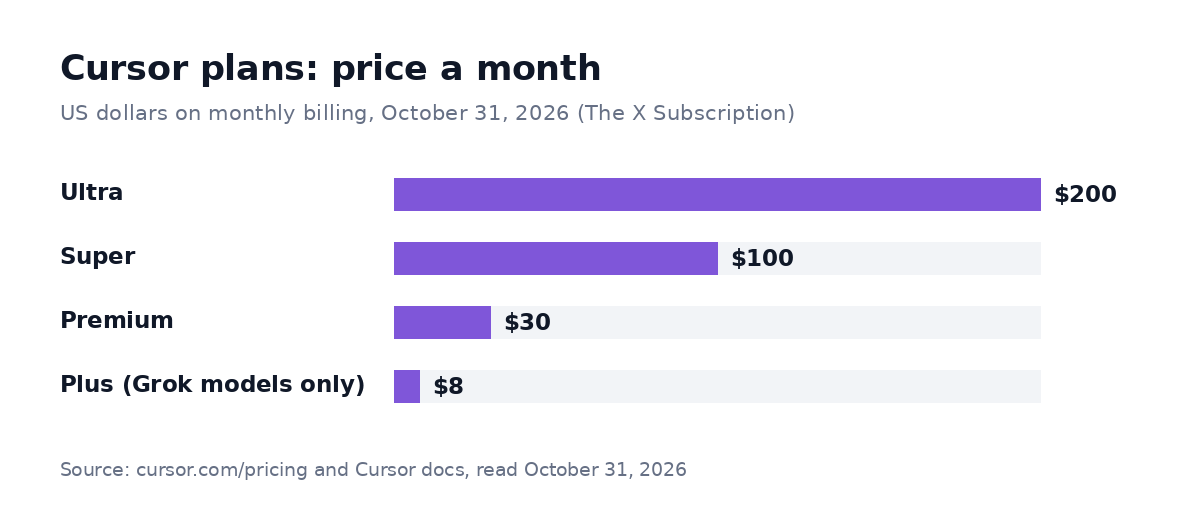
Figure: monthly price per plan on The X Subscription, from Cursor's pricing documentation on October 31, 2026. Annual billing is $80, $300, $1,000 and $2,000 a year.
How usage is counted
Each paid plan includes one weekly pool. Cursor's docs say it is "shared across" the agent in the editor, the command line, cloud agents and the Grok apps, and that "it refreshes weekly." The pool covers Cursor's own Composer model and Grok models. Plans are described as multiples of Plus (4x, 15x and 50x), and Cursor does not give a dollar size for the pool.
Past the pool, Cursor models are billed at listed token rates, for example Grok 4.7 at $2 per million input tokens and $6 per million output tokens, according to Cursor's model pricing table.
Third-party models work differently. Claude, GPT and Gemini "aren't part of the included pool," the docs say. "On Premium and above, they're available in Cursor at the model's API list price from the first request, paid from your prepaid credit."
For a team that mostly codes with Claude or GPT, the seat price covers access, and the model use is a separate, usage-based bill.
What teams pay extra
Three items add to a team's bill:
- The Cursor Token Rate. "On Teams and Enterprise plans, eligible third-party model requests include a Cursor Token Rate of $0.25 per million tokens." It also applies when you bring your own API key. "Individual plans don't pay it."
- Bugbot. Cursor's code review bot moved from "a $40 per seat per month subscription to usage-based billing," Cursor announced in May 2026, and "the average Bugbot run costs $1.00-$1.50."
- Data residency. "Opting in to regional data residency incurs a 10% uplift on Model pricing for eligible Models."
Admins control spend with limits: they "set one monthly additional usage limit for the whole team," plus a default limit per member and overrides. Cursor "bills per active paid seat."
What changed for existing customers
If you bought Cursor before the change, your plan is now a legacy plan. Cursor's legacy plans page maps each one:
| Legacy plan | Price | Closest new plan |
|---|---|---|
| Pro | $20 a month | Premium ($30) |
| Pro+ | $60 a month | Super ($100) |
| Ultra | $200 a month | Ultra ($200) |
| Teams Standard | $40 per user | Premium seat ($30) |
| Teams Premium | $120 per user | Super seat ($100) |
Cursor says each new plan "includes at least twice as much coding usage with Cursor models as the legacy plan it replaces." But "it also drops the included third-party model allowance." Switching is "optional and permanent." If your team relies on Claude or GPT, compare a month of your real usage before you switch.
Privacy and your code
For companies, Privacy Mode is the setting that matters. Cursor's data use page says: "If you enable 'Privacy Mode'… Customer Data will not be used for training by Cursor," and that it "maintains zero data retention (ZDR) agreements with all providers." Cursor also says models without zero data retention are flagged or need an admin to opt in.
With Privacy Mode off, Cursor "may use and store codebase data, prompts" to improve its features and "train our models."
Teams plans include "team-wide privacy mode enforcement," SAML and OIDC sign-in, usage analytics and custom chat data retention. Enterprise adds pooled usage, invoicing, SCIM and "granular spend controls." Turn privacy mode on for the whole team before anyone opens a client repository.
What a 10-developer team pays
Here's a budget for 10 developers on Premium team seats, at the prices in Cursor's docs:
- Seats: 10 × $30 × 12 = $3,600 a year.
- Third-party model use: at API list price plus the $0.25 Cursor Token Rate. Our assumption: 2 billion tokens a year on Claude Sonnet 5.5, 1.6 billion input at $2 per million and 0.4 billion output at $10 per million, with no caching. That is $3,200 + $4,000 = $7,200 at list price, plus 2,000 × $0.25 = $500 for the token rate.
- Bugbot: at Cursor's May 2026 average of $1.00 to $1.50 a run, 200 reviews a month cost $200 to $300, or $2,400 to $3,600 a year, taken from included usage first, then from the team's prepaid credit. The Bugbot docs now point to the pricing page for current rates, so check them before you budget.
- 12-month total: $3,600 + $7,200 + $500 + $2,400 to $3,600 = about $13,700 to $14,900, before your own setup and admin time. Caching and cheaper models such as Claude Haiku 5.5 lower the model line.
So the seats are the predictable part, and model use and Bugbot are the variable part. The token volume and review count are our assumptions: set a monthly team limit for the first quarter and read the usage report before you raise it. Add your own time to set up rules, privacy settings and code review.
Settle these before you roll it out
A few decisions save money later, so make them before the first developer logs in:
- Which models are allowed, since third-party models cost list price on top of the seat.
- The monthly team limit, and the default limit per developer.
- Whether Bugbot runs on every pull request or only on the ones a reviewer requests.
- Privacy Mode enforced for everyone, checked in the admin settings.
How to choose a plan
Here's a quick guide:
- One developer happy with Grok and Cursor models: Plus at $8.
- A developer who wants Claude or GPT and cloud agents: Premium at $30, with model use on top.
- Heavy daily agent use: Super or Ultra, or the same tiers as team seats.
- A company that needs SSO, enforced privacy and spend limits: Teams or Enterprise.
When to hire developers instead
An AI code editor speeds up developers; it does not replace them. When you need someone to build an AI feature, an agent or an integration, you can browse AI agent developers and AI app developers on RemoteAI and message them from their profile. For budgets, see our guides to hiring an AI engineer and AI engineer salaries, or post your project with your stack.
Next steps
Your next step is to check which models your developers actually use. If it is mostly Claude or GPT, budget Premium seats plus usage at list price, and set a team usage limit from day one. If you are on a legacy plan, compare a month of usage before you switch, since the change is permanent.
Sources: Cursor pricing; Cursor docs, models and pricing; Cursor docs, team pricing; Cursor docs, legacy plans; Cursor docs, Bugbot; Cursor blog, Bugbot changes, May 11, 2026; Cursor blog, joining SpaceX, August 14, 2026; Cursor data use, updated September 3, 2026; all read October 31, 2026.