AI for insurance works best today on paperwork: reading applications, loss runs and claim forms, sorting submissions, and answering policy questions from your own documents. Pick the one task that costs your team the most hours, use a tool that reads your real files, and keep a licensed person on every decision that affects a client.
If you run an agency, an MGA or a small carrier, the hard part is not finding AI tools. It's choosing a use case worth the effort and staying inside the state rules that now cover AI. This guide covers seven use cases, buy versus build, the regulations, and a first project you can measure.
How insurers use AI today
Insurers already use AI across most of the business. The National Association of Insurance Commissioners (NAIC) says it is used in "underwriting, pricing, customer service, claims handling, marketing, and fraud detection" (NAIC AI topic page, updated April 3, 2026).
The NAIC also surveyed insurers line by line. Here's what each survey found about companies that use, plan to use or plan to explore AI or machine learning:
| Line | Insurers responding | Share using, planning or exploring AI | Report date |
|---|---|---|---|
| Auto | 193 | 88% | December 2022 |
| Home | 194 | 70% | August 2023 |
| Life | 161 | 58% | December 2023 |
| Health | 93 | 92% | May 2025 |
These figures mix current use with plans, so read them as interest, not deployment. They cover carriers, not agencies. That's why the useful signal for an agency is simple: your carriers are building AI programs and will ask how you use AI on their business.
The 7 AI use cases in insurance, and what each needs
Here's how the seven use cases compare. Vendor names are examples documented on their own websites, not recommendations:
| Use case | What AI does | Data it needs | Example tools | Who builds it |
|---|---|---|---|---|
| Claims intake and FNOL | Captures the first report, reads photos and forms, routes the claim | Claim forms, photos, policy data | Tractable for damage photos | Buy for photo estimates; build intake routing |
| Document extraction | Pulls fields from applications, dec pages, loss runs and claim forms | PDFs and scans of your real forms | Azure AI Document Intelligence | Build with a document AI specialist |
| Underwriting submission triage | Reads submissions, checks appetite, ranks what to quote first | Submissions, loss runs, appetite guides | Sixfold | Buy at carrier scale; build for an MGA's own appetite |
| Fraud signals | Flags claims that look unusual for an investigator | Claims history, notes, third-party data | Shift Technology | Buy; build simple rules first |
| Policy and coverage questions | Answers staff or client questions from your own policy documents | Policy forms, endorsements, internal guides | Custom RAG assistant | Build |
| Quote and renewal follow-up | Drafts reminders and follow-ups from your system data | Agency management system, email | Workflow tools plus a language model | Build |
| Compliance review | Checks marketing and letters against your rules, logs AI use | Your rules, templates, AI inventory | Custom checklist workflow | Build, with your compliance lead |
The rest of this guide takes each row in turn, starting with the one most agencies feel every day: documents.
Document extraction: the first place to start
Document extraction turns a PDF or a photo into fields your system can use. Because applications, declaration pages, loss runs and claim forms follow patterns, this is often the quickest win.
Microsoft's prebuilt health insurance card model is one documented example. It reads US health insurance cards and extracts information such as insurer, member, prescription and group number into structured JSON (Microsoft Learn, read October 28, 2026).
For P&C forms such as ACORD applications, you can train a custom model on your own samples. The same documentation lists limits for custom training: up to 500 pages for a template model and 50,000 pages for a neural model.
Test it before you trust it: run 50 forms your team already keyed in through the model and compare each field. If errors are low on clean PDFs but high on scans, send scans to a person.
Who does the work: a document AI specialist builds the extraction and the hand-off to your agency management system. Our guide to AI document processing explains how these projects are scoped.
Claims intake and first notice of loss
Claims intake is where speed matters most to the policyholder. AI captures the first notice of loss from a form, chat or call transcript, checks it against the policy, and routes it to an adjuster with a summary.
For auto and property damage, photo-based tools are mature. Tractable says its AI assesses damage to vehicles and properties from images and gives a certainty score with each estimate (Tractable website, read October 28, 2026).
An agency rarely builds a damage model. The useful build is the routing: a workflow that reads the report, fills the claim fields and flags missing documents. If clients call after hours, a voice agent can take the first report, as our guide to AI voice agents explains.
Underwriting submission triage
Submission triage answers one question fast: is this risk worth quoting? Commercial submissions arrive as emails with loss runs, statements of values and applications attached, and underwriters spend hours just reading them.
Sixfold says its product reads documents such as loss runs and SOVs and evaluates appetite and portfolio fit on every submission. Its website advertises 50% improved efficiency and a 15% increased quote-to-bind ratio (read October 28, 2026). Those are the vendor's own figures, with no method or baseline shown, so test them on your own submissions.
An MGA with a narrow appetite can often build a lighter version, since its rules fit on a page. It extracts key fields, compares them with the appetite rules, and ranks the queue. The underwriter still decides.
Fraud signals
Fraud tools flag claims that look unusual so an investigator can look first. The Coalition Against Insurance Fraud puts the cost at "at least $308.6B every year" for American consumers (Coalition website, read October 28, 2026). The page does not name the study behind the figure.
Shift Technology says its agents assess claims for fraud, assign cases and guide investigations (Shift website, read October 28, 2026).
A flag is not a finding. In other words, a person reviews every flagged claim before any adverse step, and you keep a record of why.
Policy and coverage questions over your own documents
A coverage assistant answers questions like "Does this BOP cover spoilage?" from your own policy forms and endorsements, and shows the page it used. This method is called retrieval-augmented generation (RAG): the assistant searches your documents first, then writes an answer from what it found.
Start with internal use: account managers ask, the assistant answers with a citation, and the person checks the clause before replying. Client-facing answers come later, if ever, because a wrong coverage answer is an errors and omissions problem.
Here's a brief you can adapt:
"Build an assistant that answers coverage questions from our policy forms and endorsements for [lines of business]. Every answer must quote the form number and page it used, and say 'not found' when the documents don't answer. Users: [8 account managers]. Documents: [about 1,500 PDFs in our agency management system]. Done when it answers 40 test questions correctly that our senior CSRs wrote."
RemoteAI lists RAG engineers and chatbot developers who build this kind of assistant.
Quote and renewal follow-up, and compliance review
Follow-up is a workflow problem more than a model problem. A workflow pulls policies expiring in 60 to 90 days from your agency management system, drafts a reminder with the right details, and puts it in the producer's queue to approve and send.
The same pattern works for open quotes. Our page on automation and AI workflow specialists lists people who build these pipelines.
Compliance review is the reverse: AI checks your own output against a checklist your compliance lead wrote, and you keep an inventory of which AI tools touch which decisions. The NAIC bulletin expects insurers to know exactly that.
What to buy, and what to build with a specialist
Buy when a product already reads your data and fits your process; build when your forms, appetite or workflow are specific to you. In practice:
- Buy: damage estimates from photos, carrier-scale fraud scoring and submission triage. These need training data from millions of claims or submissions that one firm can't match.
- Build: extraction from your own forms, a coverage assistant over your documents, renewal and quote follow-up, and connections into your agency management system.
- Build carefully: any model that scores people for pricing, underwriting or claims. It falls under the state rules below.
Here's the skills gap to plan for. AI skills are common on RemoteAI, but few profiles mention insurance:
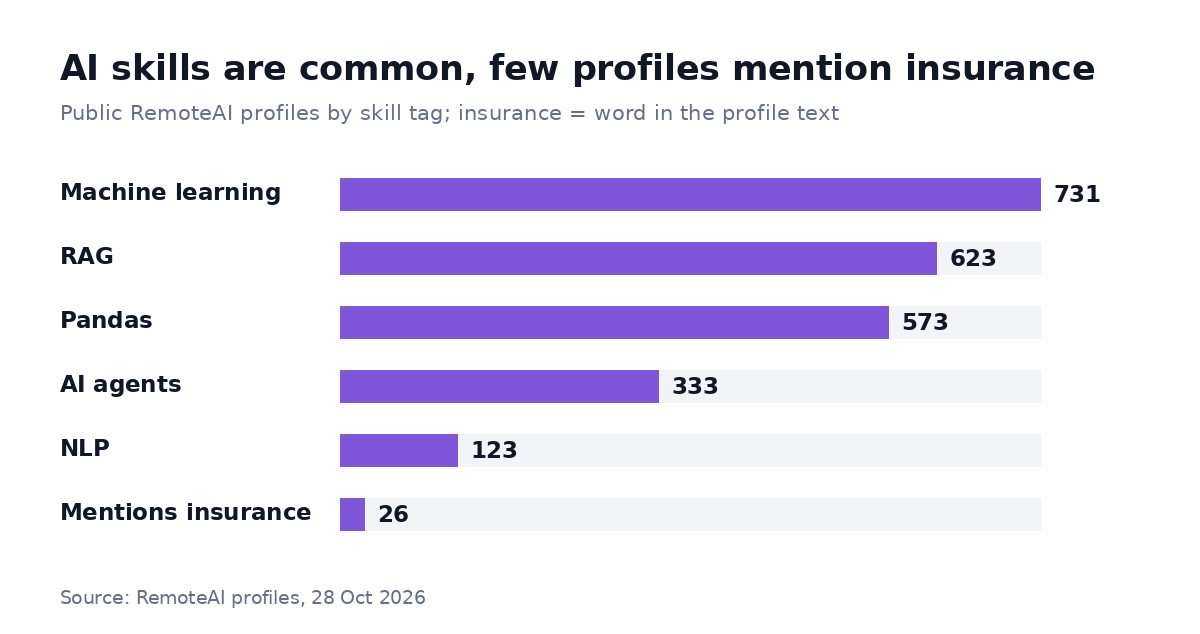
Public RemoteAI profiles, out of 3,493, counted on October 28, 2026. Skill bars count profiles tagged with the skill (machine learning includes scikit-learn and XGBoost; RAG includes LlamaIndex). "Mentions insurance" is a different measure: profiles with the word in their headline or description, so it is a floor, not a count of insurance experience. Python alone appears on 2,251 profiles.
So write the brief in insurance terms. A developer who knows RAG can learn what a loss run is in an afternoon if your brief explains it, but can't guess your forms or your approval steps. Engineers for the scoring work are on our machine learning engineers page.
The rules: NAIC bulletin, Colorado and human review
Insurance AI is regulated by the states. The main text is the NAIC Model Bulletin on the Use of Artificial Intelligence Systems by Insurers, adopted by the NAIC on December 4, 2023: a model that each state's insurance department can issue as its own bulletin. It is regulatory guidance, not a federal law. It expects insurers to "develop, implement, and maintain a written program (an 'AIS Program')" for AI systems that make or support decisions in regulated insurance practices.
Which states adopted it? The NAIC's implementation map, with status as of October 8, 2026, lists 29 adopting jurisdictions: Alaska, Arkansas, Connecticut, Delaware, the District of Columbia, Hawaii, Illinois, Iowa, Kentucky, Maryland, Massachusetts, Michigan, Mississippi, Nebraska, Nevada, New Hampshire, New Jersey, North Carolina, North Dakota, Oklahoma, Pennsylvania, Puerto Rico, Rhode Island, South Carolina, Vermont, Virginia, Washington, West Virginia and Wisconsin. California, Colorado, New York and Texas have their own insurance-specific regulation or guidance.
Here's what the bulletin means in practice for a buyer:
- Vendors are your responsibility. The program should cover AI systems "whether developed by the Insurer or a third-party vendor," with due diligence and, where possible, audit rights in contracts. If you're an agency or MGA building AI on a carrier's business, expect the carrier to ask for this.
- Human involvement counts. Controls should reflect "the extent to which humans are involved in the final decision-making process" and how explainable outcomes are to the consumer.
- Regulators can ask. In an investigation, an insurer "can expect to be asked about its development, deployment, and use of AI Systems." Keep the test results and the decision log.
Colorado goes further. SB21-169, signed July 6, 2021, restricts insurers' use of external consumer data, algorithms and predictive models that unfairly discriminate based on race, color, national or ethnic origin, religion, sex, sexual orientation, disability, gender identity or gender expression. Under the rules it directs the commissioner to adopt, insurers must keep a risk management framework, test their data and models for unfair discrimination, and file an attestation by the chief risk officer.
Its rule (3 CCR 702-10) took effect November 13, 2023, with amendments effective October 15, 2025, according to the NAIC map. We could not read the Colorado Division of Insurance's own page, which refused access, so check it directly for the lines of business and testing rules that apply to you.
Two more risks apply everywhere. Policy and claims files hold personal and sometimes health data, so check the model provider's data retention terms and your carrier agreements first. And if a decision is adverse, such as a declined application, a denied claim or a fraud referral, a person must be able to explain it.
How to start: a first project in 4 steps
A first project should be small enough to finish in four to eight weeks and measured by one number. Here's how to scope it this week:
- Pick one task. For most agencies that's keying one form type, or coverage questions on one line of business.
- Write down today's number. Minutes per application keyed, hours per renewal batch, or days to triage a submission.
- Test on past work. Run the tool or prototype on files where you already know the right answer.
- Decide buy or build. If a product covers 80% of the task, buy it. If not, write a one-page brief and get quotes for a fixed-scope pilot, with a decision log built in from day one.
Our guide to the implementation of AI covers the pilot-to-rollout step in more detail.
Find a specialist for your insurance AI project
Have a document extraction, coverage assistant or renewal workflow in mind? Post your project on RemoteAI with the brief above. Include your agency management system, the form types, the number of files and how you'll judge success, then compare the specialists who apply.
The Free plan covers one job a month, open for 14 days; jobs from companies whose website is not verified yet are reviewed first. You can also browse document AI specialists and RAG engineers and message them once your plan includes contact credits (free posts get them after your company website is verified).
Method and sources: NAIC, Artificial Intelligence topic page (updated April 3, 2026; survey figures from NAIC reports of December 2022, August 2023, December 2023 and May 2025); NAIC, Model Bulletin: Use of Artificial Intelligence Systems by Insurers (adopted December 4, 2023); NAIC, Implementation map of the AI Model Bulletin (status as of October 8, 2026). Colorado General Assembly, SB21-169. The Colorado Division of Insurance page on SB21-169 refused access on October 28, 2026 and was not verified. Coalition Against Insurance Fraud, fraud statistics. Vendor pages read October 28, 2026: Microsoft Learn, health insurance card model, Tractable, Sixfold, Shift Technology. Vendor efficiency figures are the vendors' own claims. RemoteAI figures: public talent profiles (3,493) counted by skill tag, and by headline or description text for insurance, on October 28, 2026. This guide is general information, not legal advice.